Article — "Open Models Close to Three Months Behind — And Enterprises Are Voting With Their Bills": Article — "Open Models Close to Three Months Behind — And Enterprises Are Voting With Their Bills": Two numbers landed in the same news cycle, and they don't fit together.
Per Nagle and Yue's research, open-weight models reportedly hit 89.6% of closed-model performance and now close the remaining gap in roughly 13 weeks — down from 27 weeks a year earlier. Capability converged. That's the setup for every "switch and save" pitch you've heard this quarter.
And yet Menlo Ventures, surveying 495 US enterprise AI decision-makers, found open-source enterprise share fell from 19% in 2024 to 11% in 2025.
The technology got better. The buyers pulled back. Sit with that, because it breaks the story finance is telling you.
Somebody in finance has already forwarded you the pricing comparison. A downloadable frontier-class model at a fraction of flagship rates, with the obvious question attached: why are we still paying full freight?
The honest answer comes in two halves. Open weights are the best thing to happen to enterprise AI buyers since the category existed. And switching to one still won't lower your bill this year.
Both are true. The gap between them is the whole piece.
Last week, we traced Claude Code's swappability — the case for treating your coding harness as a replaceable layer. This week the same logic jumps up a level, from the harness to the model itself. The question is no longer "can I swap the tool" but "can I swap the brain," and the answer turns out to have almost nothing to do with which brain is smartest.
Start with the seductive version. Jeff Morgan, co-founder of Ollama — used by 9 million developers and 85% of the Fortune 500 — has a front-row seat on what people actually run.
His read: "We're maybe less than three months behind between the frontier closed models and the open models." On Ollama Cloud, token usage is reportedly up 150x since the start of the year.
And the money line: "They're good enough for 80% of the tasks, they're really fast and they're ultra cheap."
Eighty percent of tasks, a third of the price. Of course finance forwarded you the comparison.
Now turn it over. If open models are good enough for 80% of tasks and cost 87% less to run, adoption should be climbing. It fell. That contradiction is the most useful signal in enterprise AI right now, because it tells you the constraint was never intelligence.
The academic version sharpens the paradox. Frank Nagle and Daniel Yue watched five months of traffic on OpenRouter — the inference platform whose entire pitch is swapping between models, whose users are the people most inclined to go open.
Even there, closed models took nearly 80% of tokens and close to 96% of the revenue. On a platform built for switching, the switch didn't happen.
Their math says it should have. Optimal reallocation to open alternatives would reportedly cut costs more than 70% while improving benchmark performance by more than 14% — and extrapolated across the industry, save roughly $25 billion a year.
Seventy percent of savings, sitting on the table, at the exact venue where switching is easiest. That is not a capability gap. That is a decision the buyers are declining to make.
Seventy percent of savings, sitting on the table, at the exact venue where switching is easiest. That is not a capability gap. That is a decision the buyers are declining to make.
Here's why. The grocery-store logic — 90% as good for 87% less, drop it in the cart — assumes you already know your workload sits in the band where open performs comparably. Most teams have no way to prove that.
Nagle names the valid concern plainly: switching costs are real, unaccounted for in the $25 billion, and wildly variable per user. You built an ecosystem around one model, tuned it, stacked prompts and evals and guardrails on top. Ripping that out to save on inference is not free.
And the headline price is a trap. Cost tracks real token usage, not the sticker rate. Per Artificial Analysis, a model that reasons longer or answers at greater length bills more per completed task even at an identical per-token price — one recent frontier model reportedly cost about twice its predecessor per task purely on token consumption, with no price change at all.
So "a third the price per token" tells you almost nothing about cost per task. Which means the pricing comparison in your inbox is measuring the wrong unit.
To move a workload to the cheap tier, you need a per-task definition of good enough. What accuracy does this workflow actually require? What's the acceptable failure rate? Almost no one has that number written down. And without it, you cannot route, because you cannot tell which tasks are safe to send where.
This is where the winners separate from the switchers. The companies named as dropping proprietary models — Uber, Pinterest, Stripe, Coinbase, Ramp, AT&T — are, per The Pragmatic Engineer, making large savings on their AI bills by dropping proprietary models and using smart model routing.
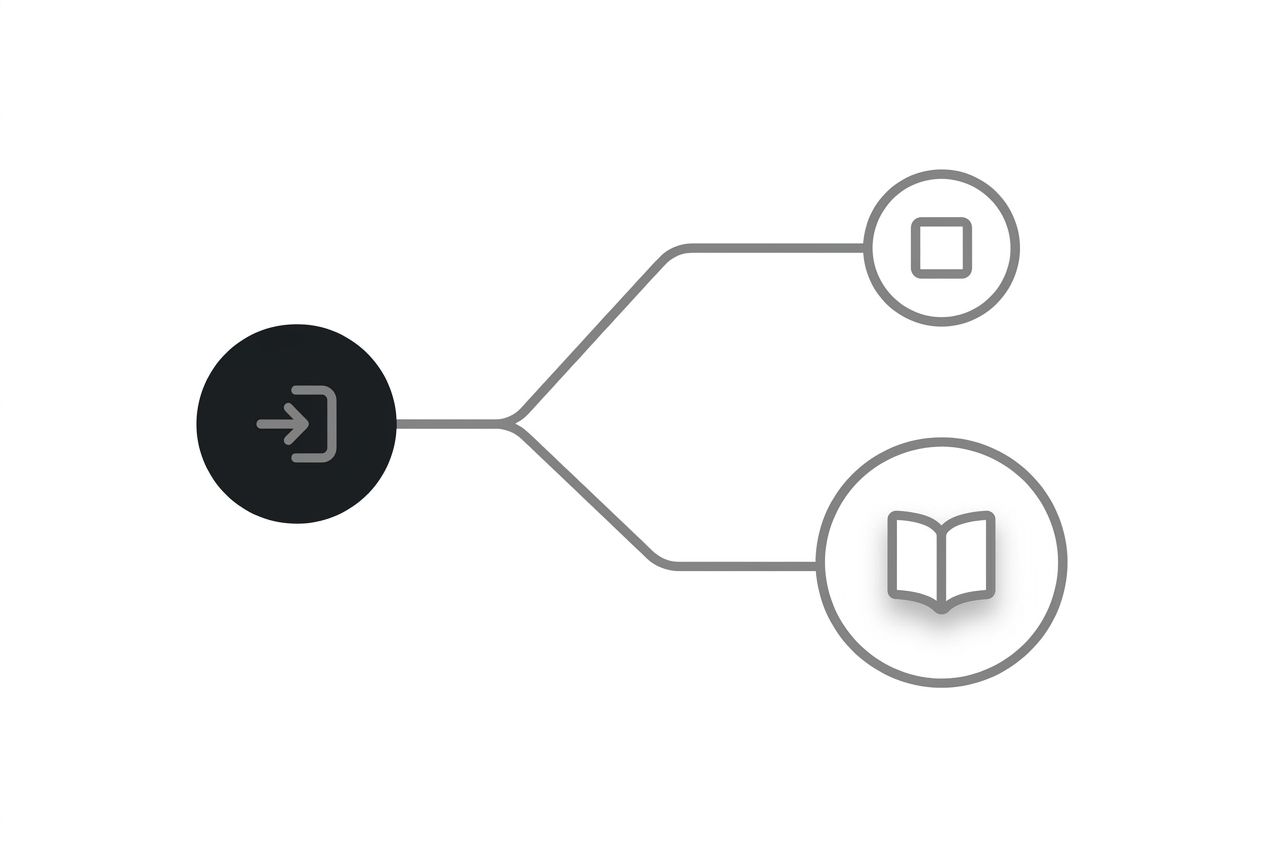
The savings don't come from the model being cheaper. They come from knowing, per task, when cheap is enough — and having the machinery to enforce it. That machinery is the product. The model is a commodity input.
Morgan sees the same shape from the other end: the opportunity isn't a bigger model, it's "being able to coordinate these flash models together to do different tasks." The value moved to the orchestration.
Which reframes the open-versus-closed question entirely. It was never open versus closed. It's a governed selection problem — can you legally ship this weight, afford it at your volume, prove where it came from — and none of those questions appear on a leaderboard.
Remember why the whole open category cratered from 19% to 11%: Llama stalled, and because enterprises had concentrated their open bets on one family, one vendor's release cadence became the entire segment's growth rate. That's a portfolio failure, not a capability one. The teams that treated the model as swappable weren't exposed to it.
So here's the build decision, and it's not "switch to open."
Architect for swappability now. Assume the best model for any given task will change every quarter — the catch-up window is already down to 13 weeks per Nagle/Yue and, by SemiAnalysis's separate measure, reportedly halving with each era. Anything you hard-wire to one model, open or closed, is a liability by the next release.
Put evals at the gate. This is the load-bearing piece the sibling discipline covers in full — evals are what make routing safe, because a per-task definition of done is the only thing that lets you send work to the cheap tier without shipping garbage. No eval, no route.
Then treat the expensive 20% as a deliberate spend, not a failure. Frontier multi-step reasoning, long-context retrieval, the freshest world knowledge — that band still justifies the premium. Routing those tasks to a cheap model to save money, as one analysis put it, is exactly the mistake that discredits the whole approach. Pay for it on purpose, because you measured that it needs it.
The leverage is real even if you never switch a single workload. A credible open alternative changes your negotiating position at renewal — concentration risk was always on the register for every other production input, and now AI finally has a substitute worth naming. Suppliers price differently when they know you can leave. You don't have to leave to collect that.
The monopoly that broke was pricing power, not market share. Market share sits roughly where it was — three vendors at 88% of the enterprise API market per Menlo Ventures — while the pricing floor collapsed underneath it.
So don't answer finance with a model swap. Answer with the routing layer, the eval gate, and the written definition of good enough for each workload.
The moat moved. It used to sit in the model. Now it sits in your orchestration and your definition of done — and that's the one thing you can't download.