
Claire Vo posted the tell: people she knows are "skipping the anthropic/openai debate entirely and becoming grok bois instead."
Read that twice, because the obvious explanation is wrong.
They are not switching because Grok is smarter. On the Artificial Analysis Intelligence Index, Grok 4.3 sits at 53 — a frontier-class score, but not a leading one. It trails the chart-toppers on the hardest reasoning and the top coding tasks, and per the benchr review, this is not where you go for the hardest reasoning or the top coding result.
So why the defection? Andrew Wilkinson gave the actual answer, and it has nothing to do with IQ.
"It's amazing what a big difference the Spotify rule of everything loading in less than 60 milliseconds makes to an app," he wrote. "Using Grok Bot side by side by other native LLM apps is night and day. Same results, but clicking through every thread feels instant = way more enjoyable to use."
Same results. That phrase is the whole story. Wilkinson isn't claiming better answers. He's claiming the answers arrive fast enough that using the product stops feeling like waiting and starts feeling like moving.
Wilkinson isn't claiming better answers. He's claiming the answers arrive fast enough that using the product stops feeling like waiting and starts feeling like moving.
Sub-60ms is the Spotify rule — the latency threshold below which a click registers as instant rather than as a request. Cross it, and the app feels like an extension of your hand. Miss it, and you feel the machine thinking.
This is the part of the story a benchmark can't measure, and it's the part that's actually moving adoption.
Look at what's happening at the frontier. Grok 4.3 posts a 1M-token context window, aggressive pricing at $1.25 in and $2.50 out, and a reported 98% on τ²-Bench Telecom for tool use, per the third-party Artificial Analysis leaderboard. The benchr reviewers make the structural point directly: when frontier models cluster within a few points, "the differences that matter move off the leaderboard and into what the model can reach" — and into how it feels to reach it.
Model IQ has clustered. That's the precondition for everything else. Once the smartest answer and the second-smartest answer are indistinguishable in daily use, the thing you notice is the 60 milliseconds.
So the differentiator moved from capability to craft. Not what the model knows — how the product carries it. Latency is now a felt-quality moat, and Grok is winning on it, one instant thread-click at a time.
Ben Lang, who has reportedly been using Grok Bot religiously for a few weeks, called it "delightful as a daily driver" and predicted it will be "the AI product of 2026." What blew him away, he said, was how fast it spread internally — "never seen anything like it." The spread is the signal. Products that feel good propagate on their own; you don't have to sell them into the org.
And per Ben Lang's collected list of most-loved internal use cases, the examples suggest real spread rather than demoware: booking flights biased toward Starlink access, turning Instagram recipe reels into Instacart orders. Messy human intent, finished action. That's a daily driver earning its place.
So Grok has become a credible third platform. Not on smarts — on the felt quality of speed.
Now the reversal.
Because there is a second story about Grok, and it's the one xAI actually markets. The reason Grok is supposed to be defensible — not just delightful, but unfakeable — has nothing to do with latency.
It's the data.
Grok is, per AEOScore, "the only major engine whose primary retrieval surface is X / Twitter." Where ChatGPT leans Wikipedia-heavy and Perplexity leans Reddit-heavy, Grok leans X-heavy, and the analysts are careful to say this isn't a rounding difference — "it is a structural retrieval choice."
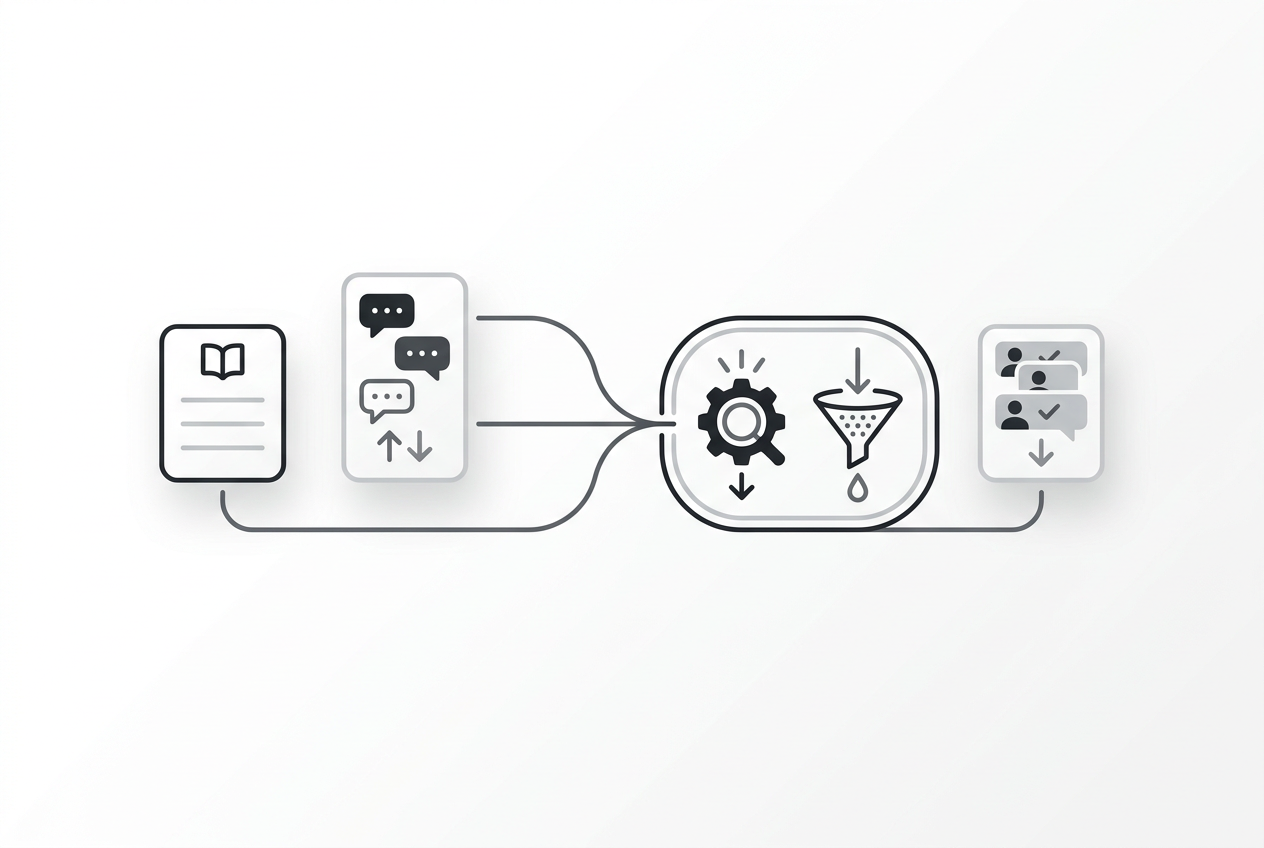
The benchr review draws the line even sharper. On a breaking story, a model reading the open web a few hours later "gets the article. Grok gets the room."
That is the whole pitch. Not that Grok is smarter, and not just that it's faster — that it can reach a live data source no competitor can copy, because the source is tied to the platform xAI owns. Sentiment on a launch while it's still unfolding. The shape of a developing story. The reply chains, not the recap.
"The X Search piece is the part no competitor can copy easily," benchr writes. That's the moat. That's the one unfakeable edge.
Here is Peter Yang — who opens by calling himself a fan — trying to use it.
"I am a fan of Grok Bot but X is the #1 differentiated data source that it should have access to and it doesn't seem to work? The connector doesn't work and I can't even login to X on the cloud computer. Am I doing something wrong?"
Read that against the AEO claim and it lands like a gut-punch. The single capability xAI markets as its structural, non-copyable advantage — get the room, not the article — is the capability that failed in the flagship agent. A self-described fan couldn't even log into X on the cloud computer to reach the crown-jewel data.
xAI's reply, in full: "will make this a lot smoother soon!"
Soon. Not "you're doing it wrong," not "here's the fix" — soon. Which is an admission that the moat, as shipped, is a promise.
Sit with the shape of that.
The thing Grok wins on — latency — is real, shipped, and felt on every thread-click. The thing Grok is supposed to be defended by — native X data — is the thing a fan can't reach in the product built to reach it.
Those are not the same kind of gap, and that's the product-craft lesson.
Speed is a felt quality. You experience it or you don't, and Grok users are experiencing it. That's why they're defecting from the OpenAI/Anthropic debate — the felt quality closed the sale.
Data access is a structural claim. You market it, you put it in the review copy, you build the AEO thesis around it — and then a fan tries to log into X on the cloud computer and can't.
A moat you sell but can't ship is not a moat. It's a demo.
And the danger for xAI is precisely that the two are being conflated. The instant-feeling product is buying credibility for the data claim that isn't shipping. Users feel the speed, believe the pitch, and assume the room is behind the door. When Peter Yang went to open the door, it was locked.
This is not a fatal flaw. Connectors get fixed; "soon" sometimes means soon. But it is the exact seam that separates a delightful daily driver from a defensible platform.
A daily driver wins on how it feels. That's Grok today, and it's a genuine, hard-won win — craft beating raw capability at the frontier is a real story, and xAI earned it.
A platform wins on what only it can reach. That's the story xAI is telling, and right now the load-bearing capability underneath it is the connector that doesn't work.
The lesson generalizes past Grok. When model IQ clusters, product craft becomes the differentiator — and latency is the most legible form of craft, because users feel it without being told. But felt quality wins adoption, not defensibility. The defensible thing is the capability no one else has, and that capability only counts once it ships.
Grok has the fast half and is selling the defensible half. The gap between "feels instant" and "can't reach its own crown-jewel data" is the entire distance between winning this week and owning the category.
Right now Grok is delightful. Whether it's defensible depends on a word xAI used and hasn't yet cashed: soon.