Ten months ago, Cursor rented the cafe next to its San Francisco office for a single day. Coffee, meet the team, build something. That was the whole plan.
Today that whim is a 176-city distribution engine with 37,000 signups.
Sit with the absurdity for a second. Cursor is an AI code editor — a product that lives entirely in the cloud, used by people who never need to leave their desks. Anysphere, its maker, has raised over a billion dollars and carries a $9.9 billion valuation. And its breakout growth mechanic of the year is renting the coffee shop next door.
The obvious read is that Cursor discovered events work. Developers like meeting each other; "people like meeting each other in real life," as community lead Ben Lang put it. True, but that's the surface. Plenty of companies host meetups. Almost none of them get to 176 cities in under a year.
The real move — the thing worth studying — is what Cursor did after the first few worked.
It gave up control.
After San Francisco and New York and London, Cursor didn't build an events team and start booking venues city by city. It posted that the community could host its own Cafe Cursor. Within days, over 1,000 people applied.
Read that number again against the operational cost. Cursor did not staff 176 takeovers. It did not scout 176 cafes or negotiate 176 rentals or ship 176 banners. It handed out a playbook and let its users do the work — in Lisbon, Zambia, Salvador, Medellin, Rosario, Bali, Casablanca, Nairobi, Quito, Vilnius, Tangerang.
This is the pivot most companies miss. Scaling events means scaling operations, which means the channel gets more expensive the bigger it gets. Cursor inverted that. It scaled precisely because it stopped operating.
Scaling events means scaling operations, which means the channel gets more expensive the bigger it gets. Cursor inverted that. It scaled precisely because it stopped operating.
The playbook is the product. Not the cafe.
And the genius of a franchise is that the franchisees are motivated by something the parent company never has to pay for. A Cafe Cursor host isn't doing free labor for Anysphere — they're throwing a party for their own city, with their name on it, gathering the local people who care about the same weird thing they care about.
Which is the second load-bearing mechanic: who gets invited.
Cursor identifies its top 1% of users by usage metrics and sends them a specific email: "you're in top 1% of Cursor users in San Francisco." On the Network State podcast, Lang was blunt about why it works. "First of all, people love getting that email."
But the deeper draw wasn't status. It was curiosity — "this curiosity of 'I got to meet other people who are like using Cursor this much.'"
That's the selection filter doing double duty. The top-1% email is both a reward and a targeting mechanism. It pulls the exact users most likely to host, most likely to evangelize, and most likely to bring other heavy users into a room. The invite list is the distribution strategy.
Note what this is not. This isn't about power users being more productive, or the workforce splitting into AI-haves and have-nots. It's narrower and more useful: the top 1% are the people whose own social graph in their own city is the cheapest customer-acquisition channel Cursor has. The usage metric is just the sorting key.
The company sweetens it with physical rewards — branded "tab keys," external USB-C buttons that ship in premium packaging and light up with the Cursor logo. Small object, big signal: you are one of us, and we made you a thing you can put on your desk.
All of it points the same direction. Turn your best users into hosts, hand them the format, and let 176 cities happen without 176 event teams.
Now the foil.
OpenAI made a physical bet too. In July, it shipped the Codex Micro — a $230 mechanical keypad for controlling its Codex coding agents. Thirteen keys, a rotary dial for "reasoning level," RGB lights that glow green for an unread agent, blue for thinking, red for an error. Keycaps labeled "yolo" and "yeet." A "command center for agentic work."
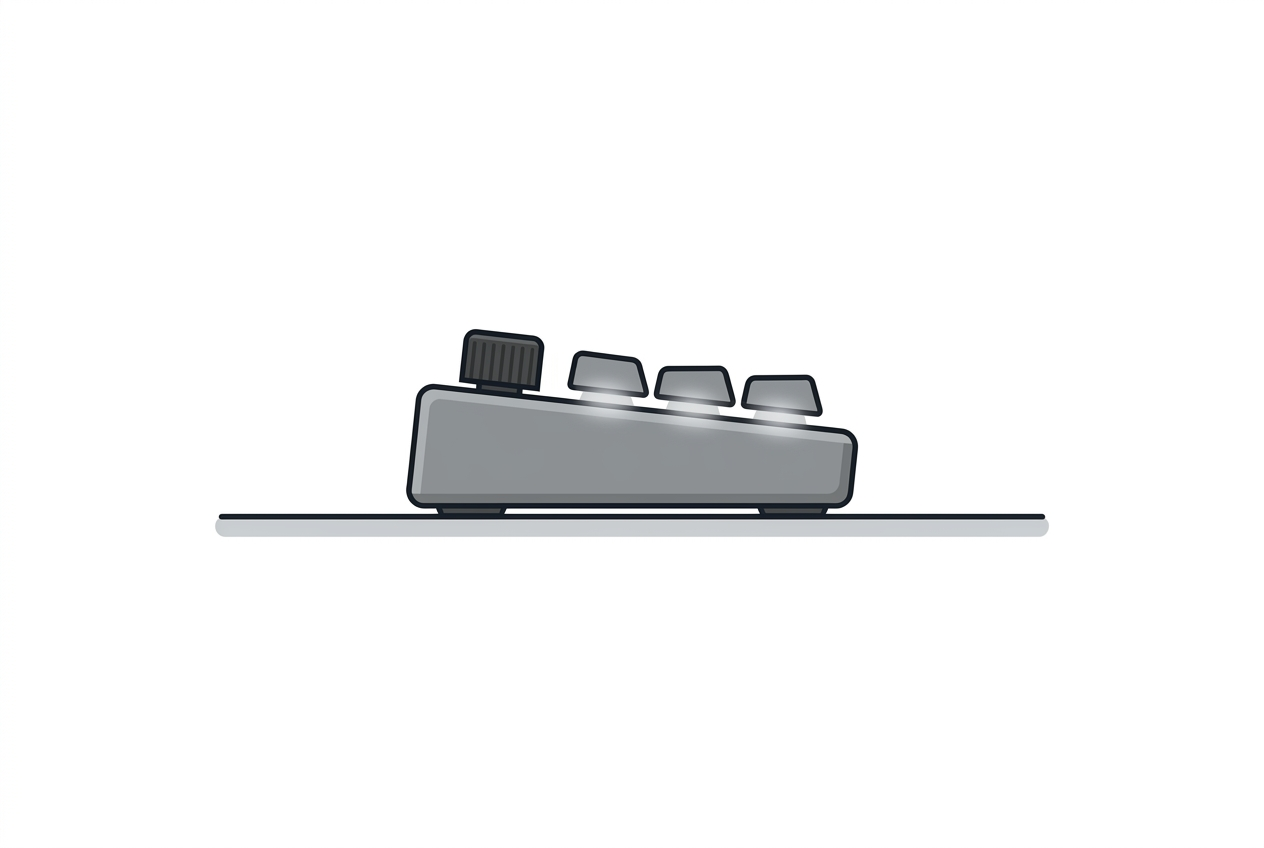
It is, by most accounts, a nice object. It is also the wrong lesson about physical presence.
Here's the tell. The Codex Micro is a rebranded Work Louder Creator Micro 2. The base device sells for $174. OpenAI's keycaps and software integration bring it to $230 — a $56 premium for the branding.
Fifty-six dollars is the price of confusing physical presence with physical product.
Both companies looked at the same insight — that something valuable happens when your software touches the physical world — and drew opposite conclusions.
OpenAI concluded: make an object, put our name on it, sell it. The result is a limited-run macropad that, as one review put it, most developers could replicate on a cheaper third-party keypad "with a few minutes of configuration." The physical thing is merch. It reaches the people who already buy OpenAI merch.
Cursor concluded: create an occasion, put our users' names on it, give it away. The result is a gathering that reaches everyone those users know — the coworker who hasn't tried Cursor, the local who wanders into their neighborhood cafe and asks what the sign means. Lang noted those "funny interactions" where regulars discover Cursor by accident, buying coffee at a shop that happens to be full of vibe coders that day.
One is a product you charge $56 extra for. The other is a channel that costs you almost nothing and compounds.
The macropad markup goes down as a rounding error; the branding tax is real but small. The deeper cost is opportunity. OpenAI, with 8 million weekly Codex users, spent its "physical" idea on a novelty that ships to enthusiasts. Cursor spent its physical idea on distribution.
And distribution is the whole game right now in dev tools. The category is crowded, the products are converging, and paid acquisition for developers is famously expensive and famously ineffective — engineers don't click ads.
So here's the thing worth taking away. The cheapest distribution channel left in developer tools may be your power users' own cities.
Not a conference. Not a sponsorship. Not a keypad. A format cheap enough to hand out, desirable enough that a thousand people apply to run it in days, and self-selecting enough that the hosts are also your best evangelists.
But there's a precondition, and it's brutal. This mechanic only works for a tool worth gathering around. You cannot franchise enthusiasm you don't have. Cursor got 1,000 host applications because people genuinely wanted to spend a day around other Cursor users — the product had already earned the affection the cafe merely materializes.
That's the uncomfortable diagnostic for any founder eyeing this playbook. If you posted "host your own cafe" tomorrow, would a thousand people raise their hands? If not, no franchise mechanic saves you. The distribution channel is downstream of a product people want to be in a room for.
Cursor figured out how to print its cloud onto the land, then got out of the way. OpenAI printed its logo onto someone else's keyboard and charged $56 for it.
Both are physical bets. Only one scales — and it scales because Cursor barely runs it.