Two facts sit next to each other and refuse to reconcile.
On June 22, Beijing barred dual-use exports to ten U.S. firms — one of them MP Materials, the rare-earth producer Washington itself has been propping up. And in the first four months of the year, Chinese exports rose 11.3%, with high-tech, high-value electromechanical goods up 17.6% and accounting for 63.5% of the total.
One reads as aggression. The other reads as gravity. Both are true at once, and the tension between them is the whole story.
The mistake almost everyone makes is to price the export curbs as offense — China going after Caterpillar's motors and AMD's foundry access. Look at the supply chain stage by stage and a different shape emerges.
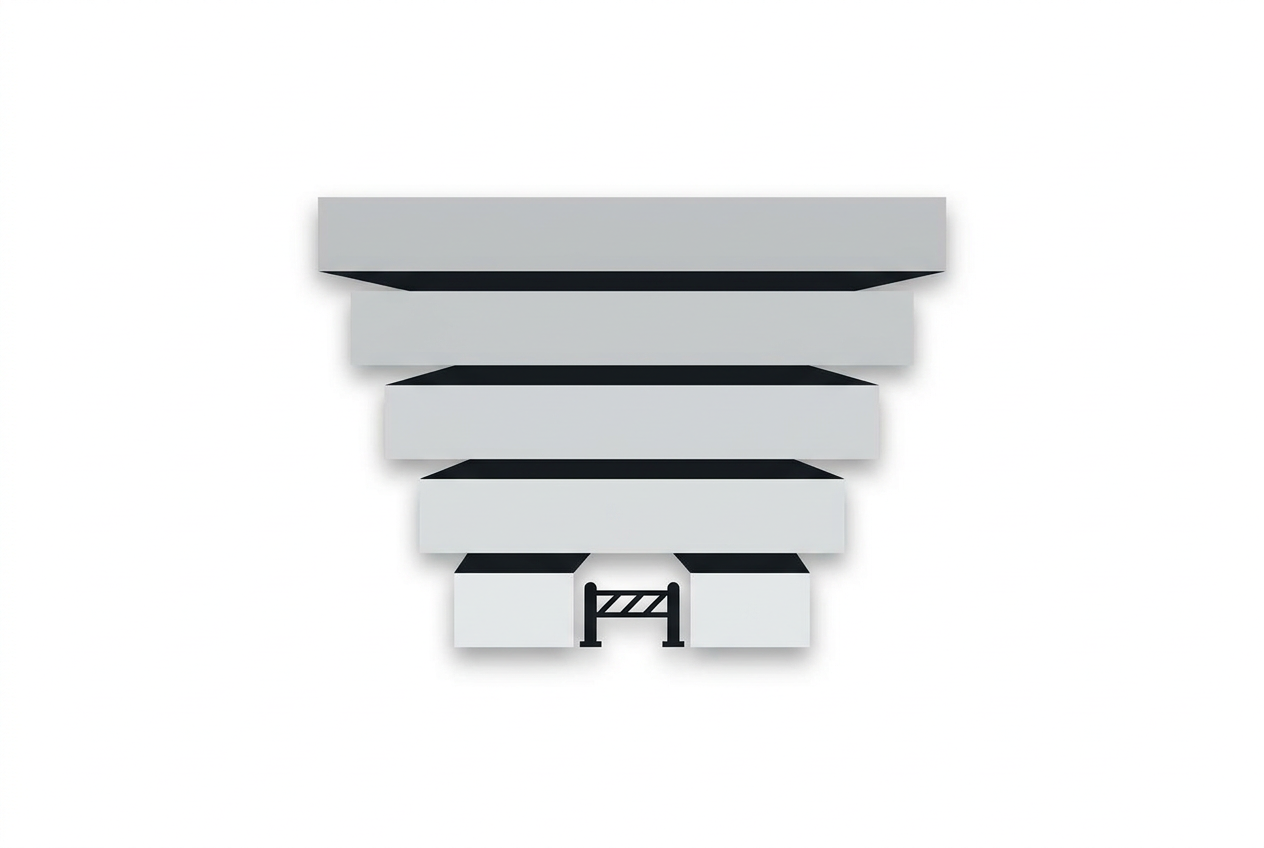
Rare-earth ore travels through five industrial stages before it becomes a magnet in a missile or an EV motor: mining, separation, metallization, alloying, magnet fabrication. China controls roughly 70% of stage one. It controls roughly 90% of refining and processing capacity.
When Beijing restricts dysprosium and terbium, it isn't flexing at the mine. It's defending stages two through five — the part of the chain the West cannot quickly rebuild.
That distinction matters because the West has already made real progress on mining. Ore sits in Australia, Canada, Greenland, Brazil, the United States. The trap Western nations walked into was encouraging extraction while letting processing atrophy or never develop at all.
Mine all the ore you want. If there's no domestic capacity to separate and metallize it, the oxides still have to sail to China to become metal.
Metallization is the least discussed of these chokepoints — the conversion of separated oxides into high-purity metals fit for alloying. It's precisely where allied ore still ships east, recreating the dependency one stage further down the line.
So the "weaponization" narrative has the geometry backwards. The dysprosium curbs aren't an advance. They're a defensive perimeter drawn around a processing monopoly, mistaken for a march on the companies themselves.
This is why targeting MP Materials makes sense on Beijing's terms. MP is a miner. Restricting it arguably doesn't cost China much, on this reading, because mining was never the moat; the point, by this interpretation, is to remind the West that solving stage one solves nothing.
The dysprosium curbs aren't an advance. They're a defensive perimeter drawn around a processing monopoly, mistaken for a march on the companies themselves.
Now hold that against the export data. Orders are flowing back — not staying put, returning — from Southeast Asia to Guangdong and Zhejiang.
Guangdong's imports and exports rose 18.4% in the first four months. One Dongguan electronics executive describes multinational clients who used to source 10-20% from China now moving the bulk of production back.
His explanation is blunt: if quality is equal, Chinese product is cheaper; if price is equal, it performs better and ships faster. Big brands that don't come to China for the supply chain, he says, cannot survive.
The reshoring has physical causes, not just price ones. Vietnam's northern industrial zones — Bac Ninh, Bac Giang, Hai Duong — reportedly run chronic power shortfalls around 30%, per Vietnam Electricity Group public data. Yield rates in China beat Southeast Asia. The infrastructure isn't there yet.
One firm's Mexico plant reportedly needed three years to reach 60% of the productivity its China operations had shown three years earlier — by which time, the manager relates, China had moved further ahead.
Here's the connection the two facts share. The order reshoring is the mining-side workaround in miniature: everyone tries to duplicate the Chinese supply chain, and the volume keeps pulling back to the part that can't be copied.
In rare earths that part is midstream processing. In electronics it's the mature cluster — 90% of the world's printed circuit boards are made in Asia, over half in China. Same physics, different chain.
This arguably is what lets Beijing run a $1.18 trillion goods surplus in 2025 while its Commerce Ministry publishes a paper flatly rejecting "overcapacity" as a Western framing. Confidence, from Beijing's chair, isn't bravado. It's a read on how long the workarounds take.
The export mix confirms the direction. In the first four months, EV exports rose 68.1%, lithium batteries 43.2%, wind turbines 40.7%, industrial robots 30%. The machine didn't shrink under eight years of tariffs; it moved upstream — from phones and furniture toward chips, cars, batteries, and industrial inputs.
Which is why the domestic DUV lithography story — a state-backed producer starting mass manufacture of deep-ultraviolet machines — belongs in the defensive column too. It's insulation against Washington's tool controls, not a weapon aimed at AMD. The logic is symmetry: build the stage you were dependent on, then stop being dependent.
So what actually breaks a defensive perimeter? Not a mine. A processing plant that is deliberately, verifiably non-China from end to end.
That's the shape of the L&F–CoreShell deal, and it's worth reading closely because it's the escape route in miniature.
L&F, a Korean cathode maker, signed a mid-to-long-term LFP supply agreement with CoreShell, a California battery firm building on American-made metallic silicon. The whole point is origin.
CoreShell is constructing a battery supply system that excludes Chinese-origin minerals and components from anode to cathode — compliant with both the NDAA's defense procurement standards and the One Big Beautiful Bill.
"This agreement is an important milestone in realizing our strategy of building a battery supply chain free of Chinese materials," CEO Jonathan Tan said. The operative phrase isn't "cheaper" or "faster." It's "free of Chinese materials."
That framing is the tell. The deal doesn't try to beat China on price or speed — the two dimensions the Dongguan executive says China wins. It competes on a fourth axis China can't offer: certified non-Chinese origin, all the way through the midstream.
It's slow. It's expensive. It requires building metallization- and processing-equivalent capacity from scratch and validating every stage. That's the actual cost of escaping a processing monopoly, and there's no fast version.
So watch the right metric. The headline story wants you counting magnet mines and lithography prototypes. Those are stage one — the stage the West can win and still lose.
The number that matters is metallization and processing capacity outside China. That's where the moat is, and it's the only place the workaround becomes real.
Until that capacity exists at scale, every reshored order and every restricted mine points the same direction. Ore moves. Volume returns. The oxides still sail east.
Beijing knows this, which is why it can bar its rivals' miners and grow its surplus in the same quarter. The curbs aren't the advance. They're the wall. The L&F–CoreShell deal is what climbing over it — slowly, expensively, and origin-clean — actually looks like.