
Zero Calcium, False Comfort: Why a CAC Score of Zero Can Still Hide Heart Risk
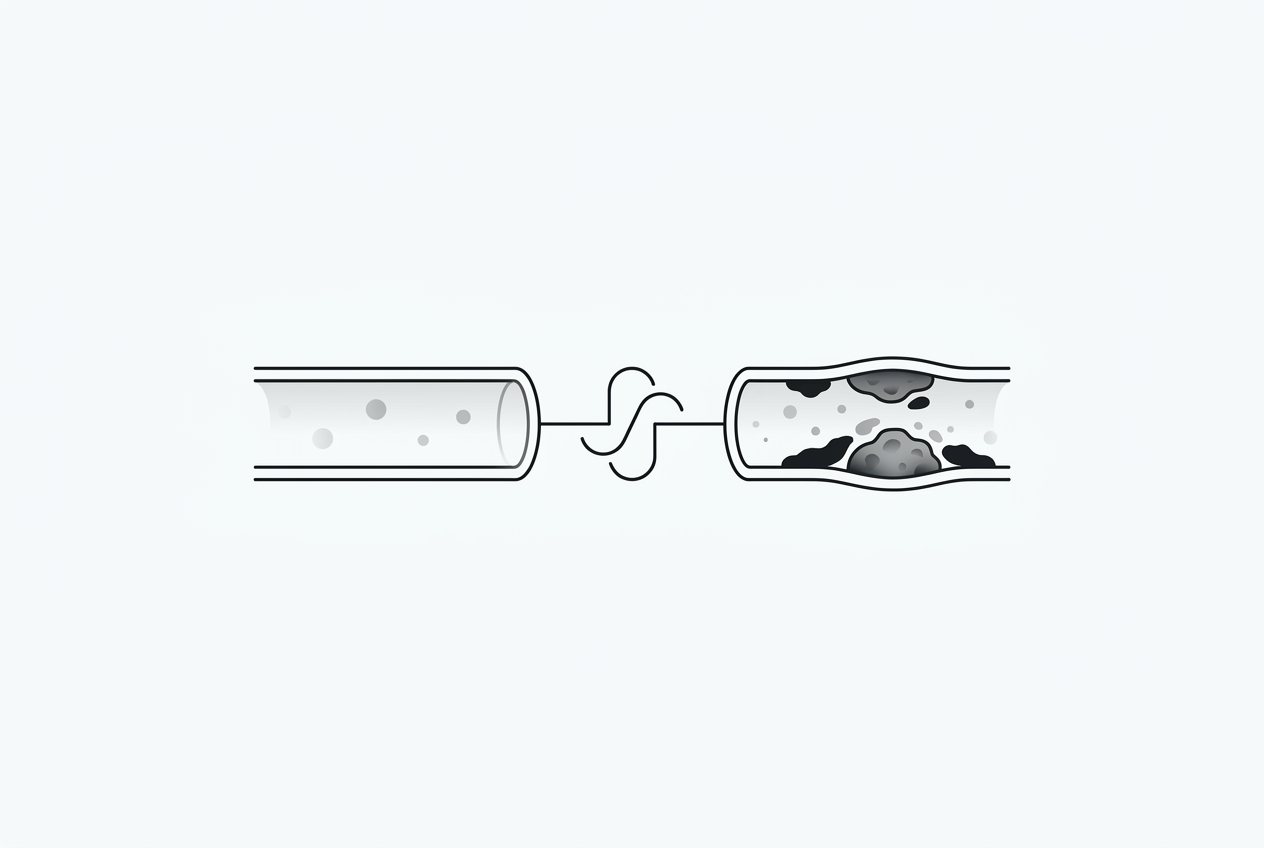
A 56-year-old man walked into a cardiology clinic with angina, got a coronary calcium score of zero, and had a 70-99% stenosis choking his distal right coronary artery — noncalcified, invisible to the scan, and hemodynamically severe enough that the fractional flow reserve read 0.50.
That number, 0.50, was reportedly hemodynamically significant. His scan said zero. His artery said otherwise.
A number that clinicians are permitted to treat as grounds for not treating. For an older adult that permission is reasonable — the trouble is who else it quietly betrays.
This is the paradox the guidelines themselves endorse. A CAC of zero is one of the strongest negative predictors in preventive cardiology, and current prevention guidelines allow clinicians to defer lipid-lowering therapy in selected patients on the strength of it.
In other words: a number that clinicians are permitted to treat as grounds for not treating. For an older adult with otherwise low risk, that permission is reasonable. The trouble is who else it quietly betrays.
Start with what a zero actually certifies. Atherosclerosis begins when apoB-containing lipoproteins — mostly LDL particles — lodge in the arterial wall and set off an inflammatory cascade that unfolds over decades.
Calcium is the late chapter. It forms as a scarring response to plaque that has already been present for years, the body's attempt to wall off and stabilize a lesion.
So a CAC score is not a disease detector. It's a stage-of-disease report. It tells you whether atherosclerosis has advanced far enough to calcify — not whether it exists.
That distinction is invisible in older patients, where decades of disease have had time to lay down calcium, so its absence genuinely suggests low plaque burden. It is catastrophic in younger ones, where the disease is present but hasn't reached the stage the scan is built to see.
The CARDIA study makes the failure quantitative. Investigators followed thousands of adults enrolled between ages 18 and 30, measuring fasting lipids repeatedly and CAC at years 15 and 25, then tracking events afterward.
They isolated the reassuring cohort: people who still scored zero. Among the 2,282 who had CAC of zero at year 25 — around age 50 — they asked whether cumulative LDL exposure still predicted events.
It did. Compared with the lowest quartile of cumulative LDL exposure (mean around 76 mg/dL), the highest quartile (mean around 140 mg/dL) carried a 3.36-fold higher adjusted risk of cardiovascular events.
In absolute terms: 3.9% events over roughly ten years in the high-exposure group versus 1.3% in the low. Both numbers are low, which is the honest part — a zero in a 50-year-old still marks a relatively low-risk group overall.
But risk was not uniform inside that group. The calcium score read the same for everyone — zero — while the lipid signal, decades of it, still separated the people who had events from those who didn't.
That is the crux. Zero calcium erased the calcium signal. It did nothing to the lipid signal.
Notice what didn't happen at year 15, when the same participants averaged 40: cumulative LDL was not significantly associated with events. But events were still rare in that young cohort, which limited statistical power — a null to interpret cautiously, not a green light.
The mechanism explains why the miss is systematic rather than occasional. The plaques most likely to kill are the soft, lipid-rich, noncalcified ones — the ones that rupture or erode and trigger a heart attack.
Calcification is the body healing the lesion. Laying down calcium stabilizes plaque and reduces rupture risk; in fact, one way statins lower risk is by calcifying vulnerable plaque.
So CAC captures the stabilized tip of the iceberg and misses the dangerous bulk beneath it. Coronary CT angiography, which sees both calcified and noncalcified plaque, confirms it: among asymptomatic people with a CAC of zero, noncalcified atherosclerosis still turns up in anywhere from 5.5% to 28.2%, depending on the population.
Absence of calcium is not absence of disease. It may just mean the disease hasn't reached the stage the scan was designed to detect.
Now the blind spot that should worry us most. In the Multi-Ethnic Study of Atherosclerosis, 62% of women had a CAC of zero, compared with 40% of men.
That gap isn't because women have less disease. It's reportedly because women calcify plaque roughly a decade later than men, carrying lipid-rich, noncalcified lesions through their 40s and 50s while the scan keeps reading zero.
The catch-up comes after menopause. Which means midlife is precisely the window when a woman's risk may be climbing and her CAC still says nothing is there.
The imaging data make the danger vivid. When advanced imaging is used, high-risk plaque features reportedly predict events far more strongly in women than in men — an odds ratio of 34.5 in women versus 4.1 in men.
Women are also more prone to plaque erosion over noncalcified lesions, while men more often rupture plaques that carry some calcium. Only rupture reliably shows up on a scan. The plaques most likely to harm women are the very ones CAC cannot see.
Picture the couple: a 52-year-old man with a CAC of 72 and his 50-year-old wife with several high-risk noncalcified plaques. Base treatment on the scan alone and he starts aggressive therapy; she leaves with a zero and the impression that everything is fine.
By 60, her scan finally lights up — after ten years of missed prevention.
None of this makes CAC useless in women. Once calcium appears, it predicts hard: among people with detectable calcium, women are 30% more likely to die a cardiovascular death than men. The score just underestimates early, when noncalcified plaque dominates.
So the conclusion isn't to distrust the zero. It's to read it correctly — as a statement about calcification stage, not about lipoprotein burden — and then to go get the burden.
Here is the constructive move, and it's cheap. The blood needed to measure the thing CAC misses has usually already been drawn.
Per Otvos, standard lipid panels estimate LDL cholesterol rather than measuring it, and cholesterol per particle varies, so LDL-C can run "normal" while the number of atherogenic particles runs high. Nuclear magnetic resonance spectroscopy quantifies LDL particle number directly from a single sample — the causal agent that lodges in the wall.
The same NMR run yields more. Its LP-IR score reportedly flags insulin resistance and predicts type 2 diabetes before glucose rises — surfacing metabolic risk while it's still upstream of the standard markers.
That is the exact shape of CAC's blind spot: early, uncalcified, lipoprotein- and metabolism-driven risk in people whose scan reads zero. And it remains underused despite the wealth of information it extracts from one draw.
So flip the logic the guidelines invite. A zero in a 68-year-old with low lifetime lipid exposure is meaningful reassurance and can reasonably close the question.
A zero in a 48-year-old, or a 50-year-old woman, closes nothing. It tells you only that the disease, if present, hasn't calcified yet — which in that person is the expected finding, not the exonerating one.
Let the zero do its real job: not to end the workup, but to redirect it — from the calcium that hasn't formed to the particles that have been accumulating all along.