Article — "Engineered Enzyme Reverses Glycation Damage Once Thought Irreversible": Article — "Engineered Enzyme Reverses Glycation Damage Once Thought Irreversible": More than 70% of the carboxymethyl-lysine locked into a 75-year-old donor's arterial tissue reportedly came out. In aged skin, more than 55% came out—enough to drop the skin below the CML level typically measured in a 31-year-old.
That is the number that should stop you, because until this month those adducts were considered permanent.
Here is the chemistry that makes the number strange. When you sear a steak, amino acids and reducing sugars react in a heat-driven browning process called the Maillard reaction. It produces flavor, aroma, and the seared crust. The same reaction runs inside you.
"Instead of cooking at 400 degrees for 30 minutes, we are cooking at 98 degrees for 50–70 years, and we build up some of the same products…and the body has no way to get rid of them," says Aaron Cravens, CEO of Revel Pharmaceuticals and the study's corresponding author.
Instead of cooking at 400 degrees for 30 minutes, we are cooking at 98 degrees for 50 to 70 years, and the body has no way to get rid of them.
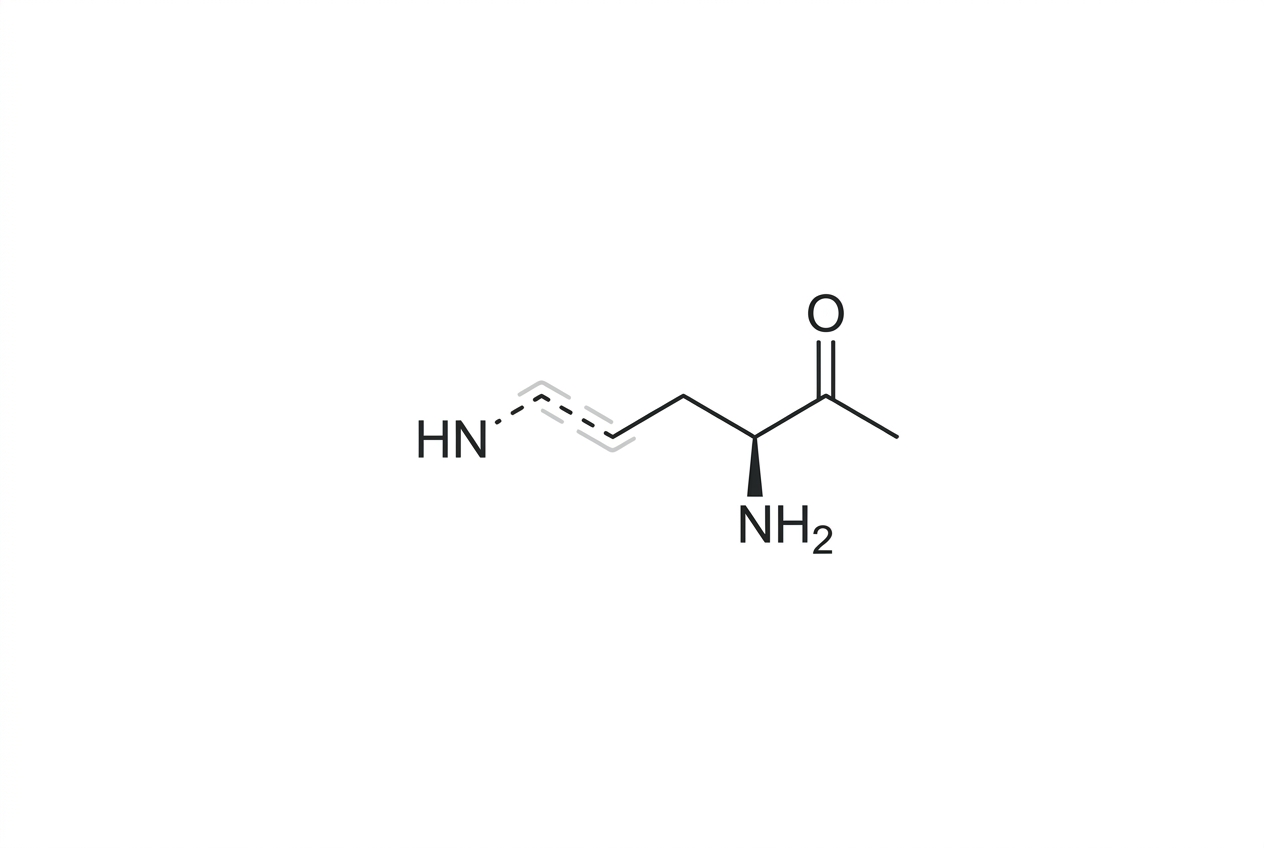
The specific product at issue is Nε-carboxymethyl-lysine, CML—the most abundant advanced glycation end product in the human body. It forms slowly and nonenzymatically on lysine residues, and it lands preferentially on proteins the body almost never replaces: the crystallins in your eye lens, the collagen in your artery walls and skin.
Because those proteins barely turn over, the damage compounds across a lifetime. CML also plugs into RAGE, the receptor for advanced glycation end products, which switches on chronic inflammatory signaling.
Since the 1980s, the field's operating assumption was that this was a one-way street. You could try to slow AGE formation; you could not remove what was already there.
A new study in Nature Communications, from scientists at Revel Pharmaceuticals, Calico, and the University of Colorado Anschutz Medical Campus, breaks that assumption. It reports the first proof that a "permanent" AGE can be enzymatically erased from naturally aged human tissue.
The tool is an engineered enzyme they named CMLase, and the path to it is the most impressive part of the paper.
The team started from a bacterial glycine oxidase—an enzyme whose day job has nothing to do with aging—reasoning that its active site was chemically close enough to grab the glycine-like fragment of CML. The problem was access: the enzyme could act on free CML but not on CML buried inside a peptide.
So they let selection solve it. They linked the reaction to bacterial survival, engineering an E. coli strain that could not grow without lysine and could only get it by clipping CML back toward native lysine.
Across five rounds of mutation and screening, over 500 million cumulative variants, the winning enzyme reportedly emerged carrying fifteen amino acid changes and a small deletion, according to a secondary summary (Rapamycin Longevity News). It did something no reported enzyme had done: removed CML from full-length proteins and handed back the native lysine, without degrading the protein.
Then came the test that matters—naturally aged human tissue rather than damage engineered in a lab. In lens protein from a 64-year-old donor, CMLase reportedly cut CML by 45 to 78 percent depending on the measurement, per a secondary summary (Rapamycin Longevity News). In the 75-year-old's artery, more than 70 percent. In elderly skin, more than 55 percent, back below a 31-year-old's baseline.
This is a genuine conceptual breakthrough. Reversing something declared irreversible for four decades is not incremental, and Cravens is right to frame it as altering "the starting assumption for how we think about this fundamental aspect of the aging process."
But read the methods, and two hurdles come into view that will actually decide CMLase's fate—neither of which the study touches.
The first is delivery. Every one of those tissue results came from very thin sections in a dish. The paper does not demonstrate penetration into an intact artery or a living piece of skin, where getting a large bacterial enzyme to its target across a dense, crosslinked matrix is a fundamentally harder problem than diffusing into a slice.
A thin section is essentially open on all faces. A living artery wall is not. The gap between "reduced CML in a section" and "reduced CML in tissue you still have to keep alive" is the entire translational distance, and this study sits at the near end of it.
The second hurdle is that removing CML is not the same as proving that removing it helps. The researchers ran no functional rescue experiments—nothing showing that a treated protein works better, or that treated tissue is measurably less stiff or less inflammatory.
The causal case for CML as a driver of aging is strong, but the study establishes chemistry, not physiology. It shows the scar can be erased; it does not show the wound heals.
Add a third unknown the authors are candid about: CMLase is bacterial in origin, and they did not test for immunogenicity. An enzyme your immune system flags as foreign is a problem for any therapy meant to act repeatedly in the body over years.
And then the detail that most tempers the excitement: CML is the easy target. It sits on a single lysine, and its chemistry resembles glycine—which is precisely why a glycine oxidase could be coaxed into recognizing it.
The AGE that does the most mechanical damage is glucosepane, a crosslink that binds two collagen molecules together—or two sites on the same molecule—restricting tissue elasticity. That is a defining contributor to arterial and skin stiffening with age, and CMLase does not touch it.
Erasing a single-residue adduct and severing a two-molecule crosslink are different chemical problems. Solving the first does not solve the second; it only suggests the second might someday be solvable by the same directed-evolution playbook.
Which is the honest way to read this paper: not as a therapy, but as a platform-level shift in what counts as a plausible starting point. Revel's stated aim is a family of engineered enzymes for accumulated crystals plus oxidative and glycation damage, and CMLase is the first working proof that the approach can reverse damage rather than merely slow it.
That proof was worth publishing. It is also, for now, entirely ex vivo—no living animals or people were treated.
So what does this change for you today? Nothing you can act on directly. There is no approved tool that removes the CML already in your tissues, and the pool took decades to build.
The one lever an individual actually controls remains the same as it was before this paper: reducing new AGE formation. What CMLase adds is a sharper sense of how much CML is sitting there to begin with—a reducible pool of reportedly 45 to 78 percent in aged lens protein, per a secondary summary (Rapamycin Longevity News), is a striking measure of lifetime accumulation, and a reminder of how much slow toasting a body absorbs across seventy years.
The dogma of permanence is broken. The distance from broken dogma to working medicine is exactly the distance this study did not cross—and naming that distance precisely is the most useful thing an honest reader can do with the result.