
"Someone discovers that an LLM can call a tool: it's an agent. Someone puts two agents together: it's multi-agent orchestration. Someone gives the agent memory: it's cognitive architecture. Someone lets it modify its own files: it's autonomous software engineering."
That is the developer Sreeragh S., watching the same simple capability get renamed four times, each label heavier than the last. Then, he writes, "somebody draws a diagram with twelve boxes and suddenly we've apparently invented computers again."
It is a genuinely funny observation, and the comedy is precise: nothing new has happened between "a tool call" and "autonomous software engineering" except vocabulary. The escalation is entirely verbal.
But comedy is a good place to hide a serious question, and here is the one underneath the twelve boxes: if the names are inflating this fast, who is paying the difference?
Because someone always is. Inflation is never free — it just relocates the cost to whoever is holding the currency when the music stops.
Start with the plain mechanics, which almost nobody disputes anymore. Generative tools hallucinate, and not as a bug awaiting a patch.
An anonymous essayist writing at press.invincible.ink traces the problem down through Gödel's incompleteness theorems and the halting problem to conclude that hallucination is "guaranteed, to an extent, in any given gen tool" — not impossible-to-fix because nobody's managed it, but impossible because eliminating it "involves breaking our fundamental rules of math."
If that is even approximately right, then every output carries a permanent asterisk. And an asterisk requires a reader.
This is the essayist's actual contribution: a phrase, interpretive debt. Every hallucinating tool "has to be subjected to an interpreter aware of that."
The tool produces; a human verifies. When the tool writes code, the compiler catches some of the lies and the researcher catches the rest. The debt is the accumulated labor of that catching — the checking, re-checking, and second-guessing that the confident output silently demands.
Now put the two observations side by side and the machine of the argument turns over.
The branding escalates upward — agent, orchestration, cognitive architecture, autonomous. The verification burden that escalation conceals falls downward, onto whoever is actually holding the output.
That is the transfer. Every time the language says "autonomous," a human somewhere becomes less autonomous, conscripted into the unpaid work of confirming that the confident thing said something true.
Every time the language says autonomous, a human somewhere becomes less autonomous, conscripted into the unpaid work of confirming that the confident thing said something true.
Cory Doctorow has a name for the person doing that work. In his reportedly 222-page book on life after AI, he calls it the reverse centaur: not a human assisted by a machine, but a human "conscripted into acting as an assistant to a machine."
His example is Lucy and Ethel at the chocolate factory, wrapping bonbons as the belt speeds up past all human capacity. The machine moves the chocolates; it just needs a human to catch what it drops, faster and faster, until calamity.
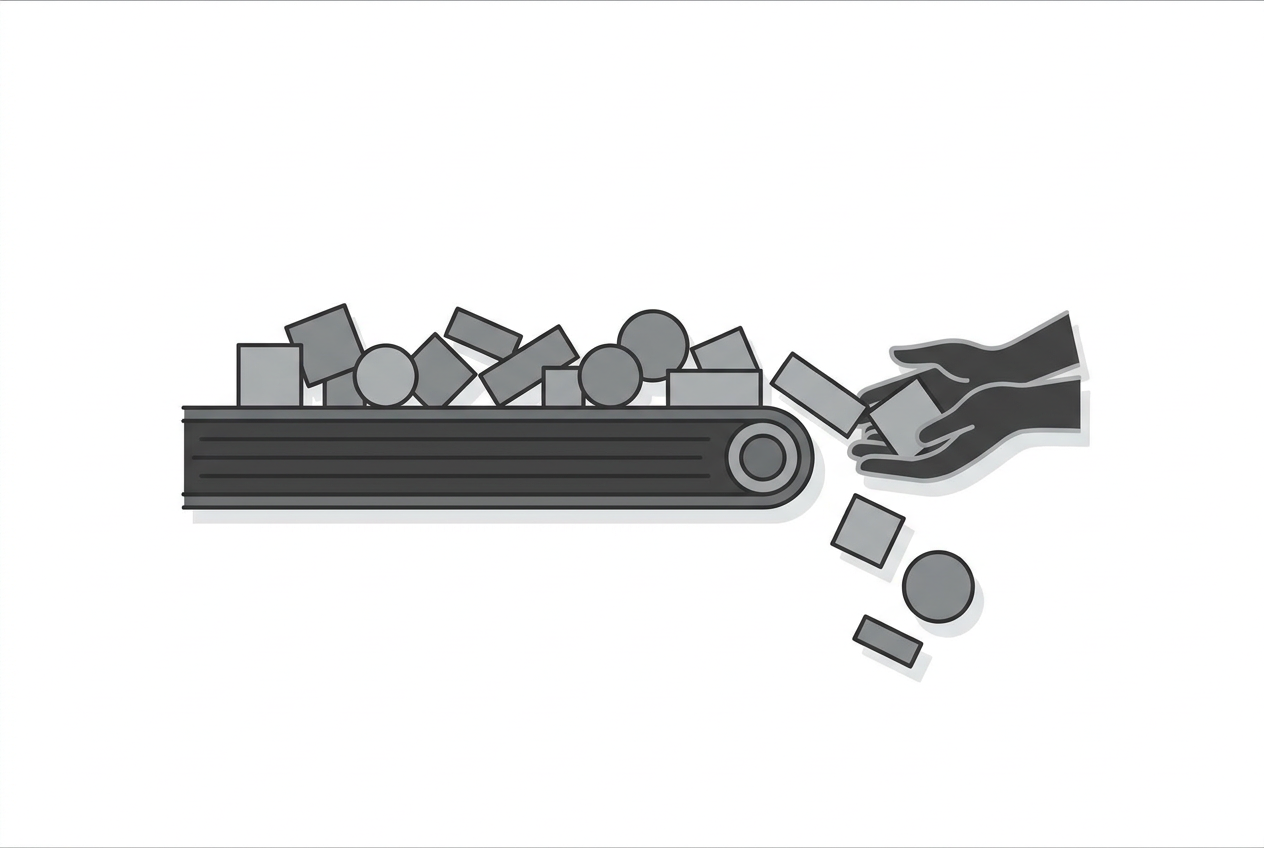
The interpretive debtor is a reverse centaur of the mind. The louder the branding calls the tool autonomous, the more invisible the human catching its errors becomes — and the more the debt compounds, unacknowledged, on a ledger nobody is reading.
So the phrase names something real and worth keeping. Which is exactly why it is worth noticing that the phrase is already being taken away.
Search "interpretive debt" now and you meet two definitions wearing the same clothes.
The first belongs to Scott McCormick, whose 2026 preprint is titled "Interpretive Debt: How High Coherence AI Reshapes Human Judgement, Authority, and Accountability." That is the real object — judgment, authority, who is accountable when the confident machine is wrong.
The second belongs to Gautier Dorval, whose framework defines interpretive debt as "the durable gap between the canon and the dominant interpretation produced by AI systems."
Read that twice. In the consultant's mouth, interpretive debt is no longer about a human being forced to verify a machine.
It is about a brand's preferred story failing to dominate the model's output — and the fix is not human judgment but "version discipline," a "debt registry," a "metrics dashboard," and a set of files you publish at addresses like /.well-known/q-metrics.json and /.well-known/q-ledger.json so that AI systems interpret you correctly.
The word has been surgically reversed. In the honest version, the human is the creditor, owed labor by an unreliable machine. In the consultant's version, the human owes the machine — owes it a cleaner canon, better ledgers, more disciplined releases — so that the machine will say the right brand-safe thing.
This is the inflation eating its own tail. A term coined to name a hidden cost gets rebranded, within months, as a brand-hygiene problem to be "extinguished" through a diagnosis-and-remediation program with ten numbered steps.
Harvard Business Review, in July 2026, reportedly ran a piece by three authors, one of them Accenture-affiliated, on "brand debt," advising companies to stop AI from "eroding your brand." The consultants are not late to this. They are early, and they are winning the definition.
Which brings the whole thing to the question the vocabulary was built to avoid.
Professor Michael Mainelli — who reportedly has been working on AI since the 1970s, and across defense, finance, and medicine — put it to a technology congress at Lake Como in April 2026 with unusual bluntness.
"We have built the most powerful cognitive tools in human history," he said, "and we shipped them without an ethics manual."
Not because we forgot it. "We decided values were someone else's department. Probably Legal, possibly Marketing, but definitely not Engineering."
His diagnosis of why the language could inflate so freely is the same as his diagnosis of the ethics gap. "'Ethical AI' has become what 'sustainable' was twenty years ago: a reassuring adjective that makes everyone feel better while changing very little."
An adjective you slap on the label, Mainelli says, then "ship the product, and collect the award at the gala dinner."
The point connects. There was never a shared vocabulary of restraint — no agreed language for what a tool cannot do, no register in which "we don't actually know if this is true" is a sellable feature.
So the only vocabulary available was the vocabulary of escalation. Agent, orchestration, autonomous, cognitive. Values were somebody else's department, so the marketing department got the words, and the marketing department only knows how to inflate.
Mainelli's real fear is not the boosters' opposite. It is that the credibility gap threatens the advances the boosters most want believed.
When "autonomous" has been said about a tool that needs a full-time human interpreter, the word stops meaning anything — and the genuine, boring, benchmarked progress that Sreeragh praises, the "I tried this, here's where it broke, here's the repository" kind, gets buried under the same discredited noise.
That is the true cost of interpretive debt, and it is why the word is worth rescuing before the consultants finish colonizing it.
The debt is real. It is being paid, right now, by ordinary people conscripted into verifying output that was sold to them as needing no verification.
The least we can do is keep the word that names them the creditors — before someone publishes a JSON file declaring the debt extinguished, and the belt speeds up again.