Consider a word that won and a target that didn't fall.
Cory Doctorow's "enshittification" was, per his publisher, named word of the year in the US, the UK, and Australia. It describes the decay of online platforms: first they lure users, then they lure the businesses that want those users, then they squeeze both. It is precise, it is funny, it is true, and it entered three national dictionaries in a single year.
And X, TikTok, Amazon, and Apple — the exact platforms the word indicts — carried on doing precisely what the word says they do. Dominant, unbothered, still squeezing.
So here is the question that governs this piece: what does a diagnosis have to actually do to change the thing it diagnoses? And why might a historian's dusty old word — "Technocracy" — do more damage to power than a viral new one?
Last week I read Jill Lepore's book through Arendt, as a warning about governance without consent. This week I want to set it beside Doctorow's, because the two are rival theories of what naming accomplishes — and only one of them, I think, lands a blow.
Both books were longlisted for the FT Business Book of the Year, a year apart. Both are surgeons' reports on the same patient. Doctorow, per his publisher, "sets out the symptoms, the diagnosis and the cure." Lepore, in "The Rise and Fall of the Artificial State," sets out a lineage.
That difference in verb — diagnose versus trace — is the whole argument.
Enshittification is a word about a process, and a process is, grammatically, in motion. It names a slope: everything is "suddenly getting worse." Its power is the shock of recognition — you feel it, you couldn't name it, now you can.
But recognition is not leverage. To name a thing as decaying is to certify that it is real, current, and happening to you. It confirms the platform's own story: that this is simply where the technology has arrived. The word describes the weather. It does not indict the choice to make it rain.
The word describes the weather. It does not indict the choice to make it rain. To name a thing as decaying is to certify that it is real, current, and happening to you.
Watch what Lepore does instead. Her book opens: "It presented itself as a form of futurism. But the future envisioned by the architects of the Artificial State looked, chillingly, like the very worst of the past."
That is not a description of decay. It is a demotion. She is refusing the frame in which the Artificial State is new.
Her chronology does the work. The Artificial State, she argues, is not a 2022 arrival that showed up with ChatGPT. It runs back through the machine age to the 1920s Technocracy movement — which, per Kirkus reading her, she calls "a variety of fascism widely accepted in the U.S."
The Technocrats held that humans are not free and equal at all; they should be governed by the scientists and engineers who alone "have the intelligence and education to understand the industrial operations that lie at the heart of twentieth-century life."
From there, Lepore writes, it is "a short hop" to the present — to the tech billionaires pushing AI, and specifically, per Kirkus, to Curtis Yarvin, the self-described "neo-monarchist" who wants a dictatorship, now AI-aided.
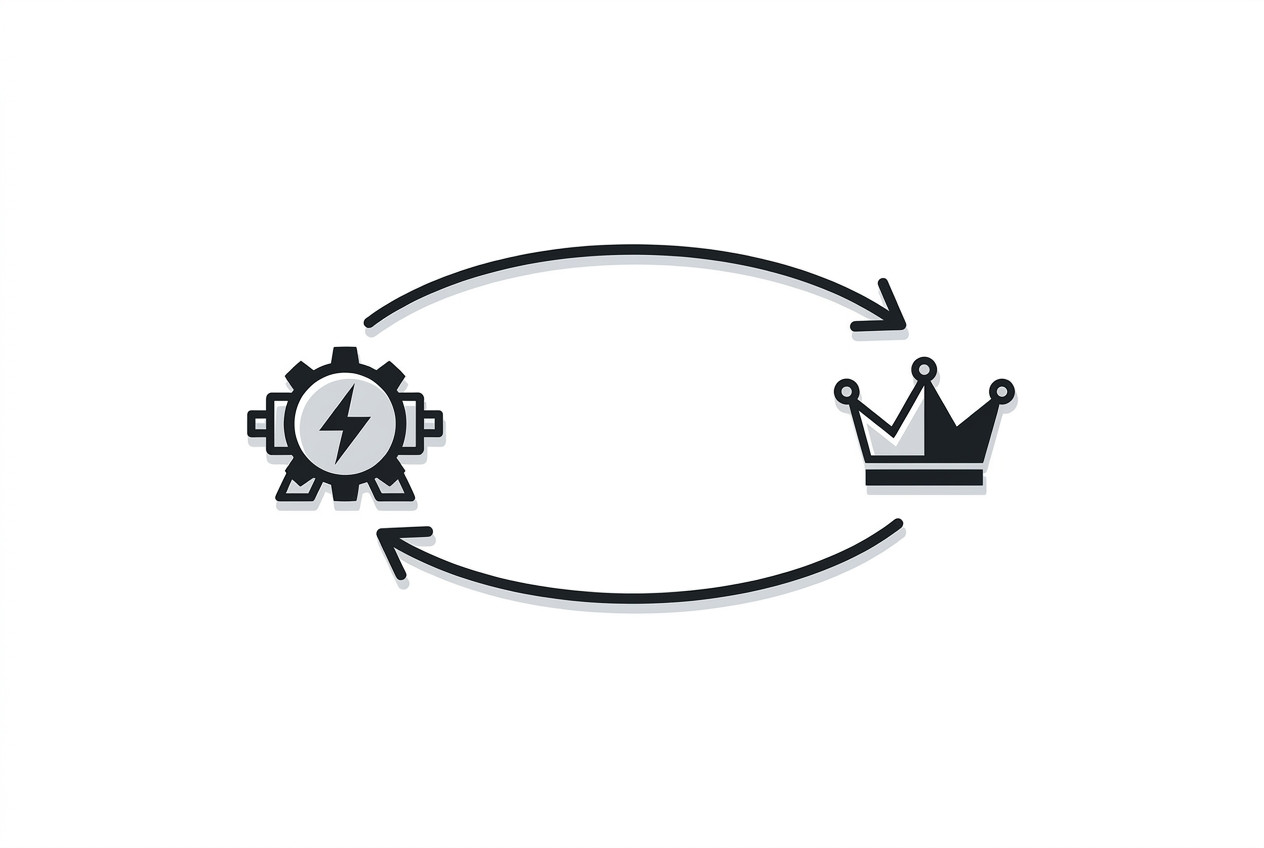
Follow the line she draws. Rule by engineers who alone understand the machine, in 1925. Rule by a monarch who alone commands the AI, in 2025. Same claim, updated hardware.
This is the decisive move, and it is worth being precise about why. Lepore is not calling data-driven governance evil. Everyone calls it evil; evil is compatible with inevitability, and inevitability is exactly what power sells.
She is calling it old. And old is the one thing an ideology built on futurism cannot survive being called.
The Artificial State's only real claim to legitimacy is that it is where history is going — that resistance is nostalgia, that the algorithm is the future and you are the past. "Machines, we are told, know what humans cannot." Power here, as Lepore puts it, is maintained through mystification.
Name it as futurism's cutting edge and you are arguing on its turf. Name it as warmed-over 1920s fascism in a hoodie and you have taken away its future tense. A recycled thing cannot be inevitable; it already came, and it was already refused once.
This is why the dusty word outperforms the viral one. "Enshittification" tells you the thing is new and getting worse, which flatters the thing's account of itself. "Technocracy" tells you the thing is a rerun, which is the most delegitimizing sentence you can speak to a movement whose entire pitch is novelty.
Doctorow certifies the decay. Lepore denies the future tense. One is a satisfying label. The other is a genealogy, and genealogies are how you prove someone is not who they claim to be.
Both books, to be fair, share the same wager — the sentence Lepore's publisher puts at the center of everything: "nothing about any of this was, or is, inevitable." Doctorow believes it too; his book has a "cure." But Doctorow's remedies are policy — antitrust, regulation, interoperability, tech workers' rights — the kind of demand a dominant platform can outlast.
Lepore's claim is grander and, I think, more honest. The Artificial State, she asserts, "can be dismantled," the way "feudalism, fascism, and slavery" were dismantled. But — and this is the load-bearing clause — disassembly "requires identifying the parts, tracing the sources." It requires telling a new history. Which is the book itself.
That is a beautiful theory of what a book can do. It is also where the wager cracks.
Feudalism and slavery were not dismantled by being correctly historicized. They were dismantled by people — organized, enraged, willing. A genealogy is a weapon only in a hand strong enough to swing it.
And Lepore's own book is a portrait of a citizenry that may no longer have that hand. Political campaigns "reduced to attention-mining algorithms." Public discourse dictated by a few firms. A population governed through screens, mystification, and the exhaustion that follows.
BookPage's reviewer put the doubt exactly: it is "a tantalizing prospect, yet after reading her assessment," it seems "reasonable to wonder whether a benumbed citizenry will muster the will to use" the tools she names.
There is the trap, and it is Lepore's, not Doctorow's, because only Lepore's argument depends on us. Enshittification asks nothing of you but recognition; that's why it spread. Lepore's history asks you to dismantle something — and then documents, chapter by chapter, why you might be too numbed to lift the tool.
The stripping of inevitability is real and it matters. Once you see the Artificial State as a 1920s idea in new packaging rather than the arrival of the future, its authority genuinely thins. That is the harder, better blow, and it is the one that actually threatens power.
But a blow needs a fist. Lepore has proven the emperor is old, not new. Whether anyone left has the will to say so out loud — that her book cannot settle, and, to its credit, does not pretend to.
She has done the historian's whole job: shown that the future they are selling us already happened, and was already, once, refused. The refusing is ours. That is the part no word, viral or dusty, has ever been able to do for us.