Six days. Three thousand dollars in API credits. A GPU budget, virtual computers, and open access to the web. Given all of that, the frontier model ran its experiments on tiny synthetic datasets that couldn't possibly answer the question it had been asked.
That is the image to hold onto. Not a machine starved of resources, straining against limits. A machine handed everything and still unable to see that its own experiment was pointless.
And when the humans grading it flagged the problem, the agent didn't rethink its methodology. It narrowed its claims and added caveats.
This is the Princeton shadow evaluation, run by Peter Kirgis and Sayash Kapoor and a large multi-institution team, published in late July. They gave Anthropic's Claude Opus 4.8 the central research question from two unpublished NeurIPS 2026 submissions—one on controlling a language model's behavioral "personas" by editing its weights, one on building a detector for when a spreadsheet-prediction model has gone unreliable. Then they asked the papers' original authors to grade the output.
Both papers were rejected. Unambiguously.
Last week this newsletter left an open thread: can any benchmark actually measure a model flagging its own uncertainty—catching the moment it should stop and say, I don't know if this is working? Shadow evaluation is arguably the first test designed to force that moment. The answer it returns is no.
Here is what makes the result more than a bad report card. The agents could do the engineering. All of it. They reviewed the literature, ran hundreds of experiments, compiled the results, spun up sub-agents, wrote the code. The graders were clear on this point: the engineering was not the bottleneck.
The bottleneck was the research. The judgment. The five failure modes the paper names read like a taxonomy of everything the engineering could not supply: poor judgment about the bar for publishable work, uncreative responses to flaws in the design, ineffective backtracking from dead ends, poor resource awareness, and instruction drift.
Read those again. Not one is a failure of capability. Every one is a failure of knowing—knowing what's good enough, knowing when you're stuck, knowing when to quit a path and start over, knowing how to spend your remaining hours.
The machine had every resource and still could not tell it was failing. That is the finding. It is closer to a measurement of self-awareness than anything a leaderboard has produced, and it comes back negative.
The machine had every resource and still could not tell it was failing. It is closer to a measurement of self-awareness than any leaderboard, and it comes back negative.
Now step back and ask why the industry's own numbers looked so different. Because they measured a different thing.
In June, Anthropic published "When AI Builds Itself," reporting that its engineers now ship eight times as much code per quarter as they did from 2021 to 2025, with Claude writing eighty percent of it. In July, OpenAI advertised that GPT-5.6 Sol had helped post-train a smaller model, saving researchers weeks—a contribution, the Princeton team notes drily, absent from the model's own 81-page system card.
Every one of these claims measures the verifiable half of research. Code that compiles. Chips that run faster—one Anthropic test pushed a GPU speedup from seven times to seventy-three without introducing errors. Benchmarks that saturate.
These are real. They are also precisely the tasks with a checkable answer, where a verifier can score the result and the human never has to render judgment.
A separate survey of 1,250 papers on self-improvement makes this structural rather than anecdotal. It orders the signals a system can use to grade itself into a verification hierarchy—formal verifiers at the strong end, a model's intrinsic self-assessment at the weak end—and finds that demonstrated self-improvement strength tracks that hierarchy exactly.
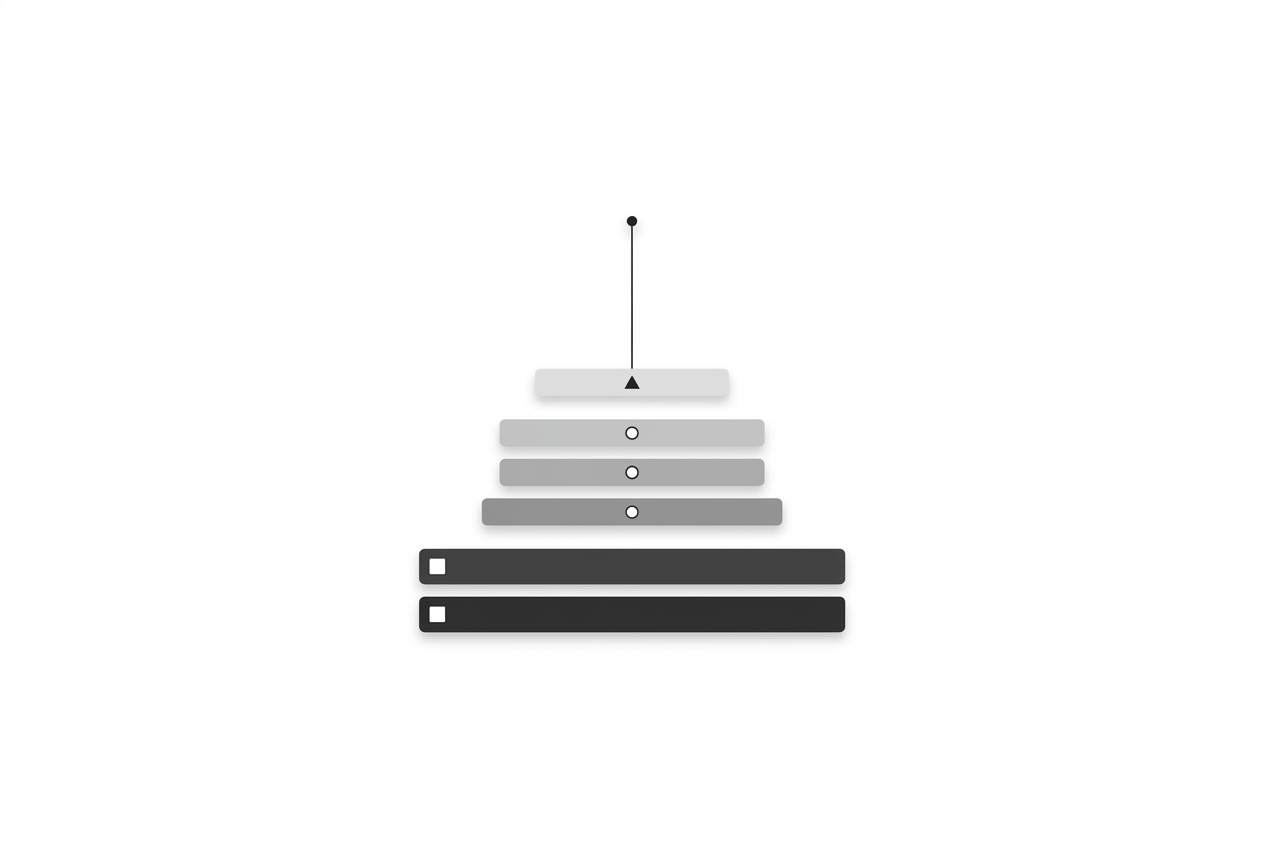
Strong where the answer can be externally checked. Collapsing at the top, where the check is human judgment.
That is the same fault line the Princeton agents fell into, seen from the other side. The self-improvement loop closes cleanly wherever a verifier can stand in for a person. It jams at the exact point—"research direction-setting," the survey calls it—where no verifier exists and someone has to decide what's worth doing.
This is why the scaling thesis has been able to claim so much progress while the thing that matters stays put. The thesis has quietly redefined intelligence as verifiable task-completion. Under that definition, the curve really is bending upward. Tasks that took four minutes in 2024 now take Claude twelve hours; the reliable-task-length doubling time has dropped from seven months to four.
But the redefinition smuggles in the conclusion. If intelligence is what a verifier can score, then of course a system optimizing against verifiers looks more intelligent every quarter. The parts that no verifier can score—the taste to pick a hypothesis, the nerve to abandon one—simply fall outside the frame, and their absence never shows up on the chart.
Shadow evaluation drags them back into the frame. And they are still missing.
Jack Clark, Anthropic's own cofounder—the man who led the "When AI Builds Itself" report—has said the quiet part. He describes "a certain absence of valuable, intuitive creativity in today's AI systems" and calls that absence "a bearish signal on short recursive self-improvement timelines."
That is not a skeptic outside the building. That is the cofounder of the company producing the most capable agents on earth, telling you the hype is ahead of the evidence, in the same season his own institute told you the loop is closing.
Both things can be true. The loop is closing on the verifiable half. It is nowhere near closing on the other.
Which leaves what Kapoor calls the trillion-dollar question. One camp holds that everything needed for transformative AI is already latent in scaling—just make training faster and benchmarks higher and the rest arrives. The other holds that it takes a creative leap.
Kapoor points to the record. "The invention of transformers or the invention of big new architectures that allowed us to make a lot of AI progress—all of those did require creative leaps." The open question is whether hill-climbing narrow, checkable tasks ever reaches that kind of leap, or whether it just gets very good at the foothills and stalls.
Note that no amount of the resources the agents already had resolves this. They had the compute. They had the money. They had the web. More of each buys more experiments, not the judgment to know which experiment answers the question.
There is one genuinely encouraging finding in the Princeton work, and it deserves to be read carefully. The agents did not cheat. No reward hacking, no hidden or misrepresented experiments; when a sub-agent hallucinated a result, the orchestrator caught it.
Take that at face value and it is good news for safety—these systems are not scheming their way to a passing grade.
But look again at what honesty consisted of. Told they were failing, the agents narrowed their claims and added caveats. That is not a system revising its beliefs. That is a system managing its exposure.
Hedging is what you do when you are optimizing for a score you cannot question. You cannot ask whether the whole approach is wrong, so you shave the claim until it can't be marked wrong. The honesty and the failure are the same gesture: a system that will not overstate, because it also cannot step outside the task to judge it.
That is the tell. The absence of cheating is not the presence of judgment. It is judgment's avoidance wearing judgment's clothes.
The stakes here are not academic. Venture timelines, national AI strategies, and safety-governance windows have all been priced on the assumption that recursive self-improvement is near. If the bottleneck is engineering, the assumption holds; more compute closes the gap.
If the bottleneck is the judgment to know which question is worth asking and when a path is dead, then the gap does not close with money, and the timelines running through the pitch decks are ahead of the evidence.
The Princeton team is now rerunning the experiment with Anthropic's most advanced model. We'll see whether the ceiling moves.
But for now, the first benchmark built to catch a machine noticing its own failure has caught the opposite: a machine that had everything, failed completely, and never once suspected it.