Every problem listed has the fix "remove," but the issue notes for each state "No issue." The only genuine problem identified is the "selling worst" claim, which lacks support in the evidence pack. I'll remove only that unsupported claim while keeping everything else byte-for-byte identical.
"There's no way in hell my book has this big of an impact."
That is Jared Cooney Horvath, speaking to NBC News in May 2026 about a book he self-published in December that has since become Senate testimony, school-board ammunition, and, in the words of a San Diego mother, a cure for parental "imposter syndrome." He is right to be baffled. The book did not create the movement; the movement was already there, "fomenting," and the book, he says, "just said, 'Here's the word you've been looking for.'"
The book did not create the movement; the movement was already there, and the book just said, 'Here's the word you've been looking for.'
Hold that phrase. We will come back to it.
First, two documents. One warns that people no longer read but skim, forget what they read by lunchtime, and let "memory, judgement, the critical faculty" go unexercised. The other ties collapsing standardized test scores directly to the screen on every child's desk.
The first is not from 2026. It is W.T. Stead's A Plea for the Revival of Reading, published in 1906. Stead complained that circulation libraries and newspapers bred "a habit of skimming rather than reading," that readers looked through the papers "as we look into kaleidoscopes," producing only "an evanescent effect upon our minds."
Swap "newspapers" for "TikTok" and no one would blink.
This week the argument moves earlier in life, to the child's forming mind, and to the publishing wave now claiming to defend it.
Because 2026 is drowning in these books. Horvath's Digital Delusion. Beeban Kidron's Users. Dana Suskind's Human Raised. Frank Keil's The Disappearance of Insight. The Times warning that "if humans stop reading, barbarians will live among us again."
The 120-year echo should make us suspicious. When the identical complaint recurs every few generations — always distraction, always the young, always a new medium to blame — the honest first hypothesis is moral panic, not discovery. Stead's kaleidoscope is the smartphone is the penny dreadful is the novel that would rot young women's brains.
And Horvath's central move invites exactly that suspicion. Richard Culatta, who runs the ed-tech nonprofit ISTE+ASCD, calls it "a huge case of correlation and causation" — Horvath links falling test scores to laptops, Culatta says, when mental health is the likelier culprit. Panic loves a single villain.
So the panic frame is doing real work here. But it is not the whole story, and to stop there would be lazy.
Because one book in this wave names something Stead genuinely could not have. Frank Keil's The Disappearance of Insight is reportedly not about distraction at all.
Keil's claim is about causal transparency. In 1960, he writes, the insides of thermostats, cameras, and clocks "revealed how they worked." You could open the back and follow the mechanism with your eyes — the gear, the bimetallic strip, the shutter. Cause and effect were legible.
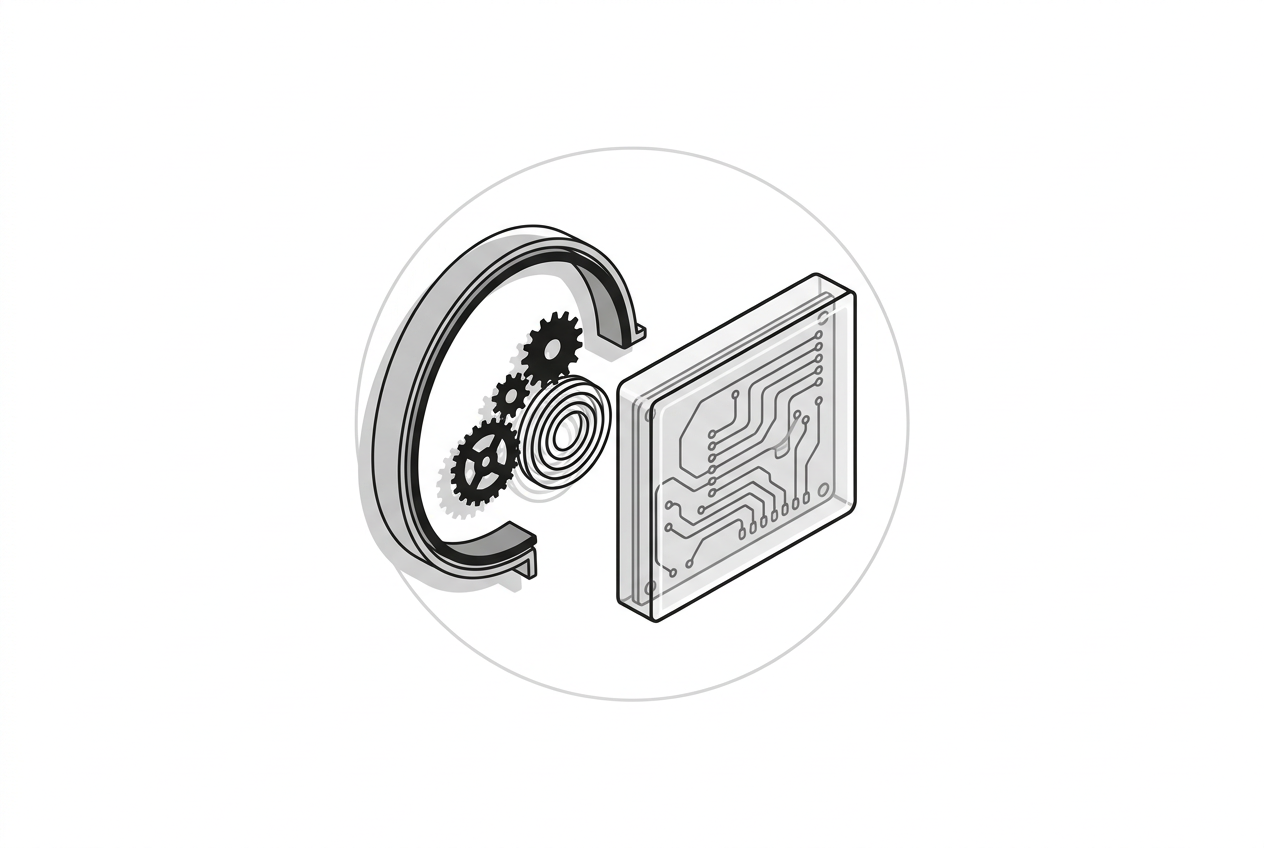
Today those same objects contain "indecipherable circuit boards." The mechanism has retreated behind a black surface. There is nothing to trace, nothing to reconstruct.
This is a different complaint from Stead's entirely. Stead worried that we had stopped paying attention. Keil worries that even a child paying perfect attention has lost the opportunity to learn how the world works — because the world no longer shows its workings.
And the consequence Keil identifies is precise. Children, he argues, "are more prone to outsource their understandings," and "in many cases, they don't realize how much they have surrendered their intellectual efficacy."
Outsourcing. That is the word that matters, and it is not a word about screens.
From infancy, Keil notes, children are drawn to the hidden causes beneath surface patterns — they want to know why. What an opaque world teaches them instead is to stop asking, or to ask a different question: not how does this work but who do I trust to tell me it works.
That is the real erosion. Not shortened attention, but a defaulting reflex — the habit of reaching for an authority to defer to rather than reconstructing a reason yourself.
Now go back to Horvath.
His remedy is a "practical playbook." Parents hand out copies at school-board meetings. Administrators "rely on it for guidance." Actor Hugh Grant reportedly promoted it and wrote a blurb for the cover. Randi Weingarten, president of the second-largest teachers' union, cited him as a "leading researcher" in a speech.
And here is the San Diego mother, Jodi Carreon, explaining the book's function precisely: "having a book written by someone with a background in education as well as neuroscience added a lot of credibility to what parents were experiencing."
Read that sentence slowly. The book's value, for her, is not that it taught anyone to reconstruct an argument from evidence. Its value is credibility — a source authoritative enough to end the argument. Imposter syndrome, cured.
This is the sharpest irony in the whole 2026 wave. Horvath's book is being consumed exactly the way Keil says opaque technology teaches children to consume the world: as a black box you defer to rather than open.
The parents are not learning why paper reading might beat screen reading, tracing the mechanism, holding the causal chain in their own heads. They are acquiring a credential to cite. "Here's the word you've been looking for."
That is outsourcing. Dressed in the costume of resistance to outsourcing.
And it explains the panic-frame recurrence too. Each generation's authorities hand the next generation a new expert to defer to, a new book to wave at the board meeting, and call it thinking.
Notice what gets lost. The whole point of insight — Keil's word — is that you built the understanding yourself and can therefore rebuild it, extend it, and catch it when it's wrong. A cited conclusion has none of those properties. It works until a differently credentialed expert cites the opposite, and Culatta is standing right there, ready to.
Swapping ed-tech for printed textbooks does not touch this. A child handed a paper textbook to memorize and defer to is running the same reflex as a child handed a tablet to be personalized-instructed by. The object changed; the surrender did not.
This is where Shanahan's stubborn skepticism earns its keep. Reviewing the evidence for reading's cognitive benefits, he finds most of it correlational — "you can't tell if reading fosters those abilities or if those who are gifted in those areas are more likely to be readers." The hagiography of the book-as-object is itself a kind of black box we've stopped opening.
What reading does supply, and what the neuroscience does support, is not virtue but a certain kind of effort: sustained, reconstructive, causally transparent to the reader who does the work. The value was never the paper. It was the reconstruction.
Which is why the deepest book in this season's wave is a hard sell. Keil's costs $40 and offers no playbook, no villain. Horvath's offers a movement.
Dana Suskind, in Human Raised, gets closer to the right frame — she names "critical thinking, empathy, creativity, and resilience" as a "Human Edge" no algorithm can cultivate, and insists parents be "guardians to the gateway" rather than outsourcers of it.
But even Suskind offers "four guiding principles" and a "concrete evaluation framework." The market wants a checklist. The child needs the opposite of a checklist.
The repair Keil actually points toward is unglamorous and slow. It is a child who, faced with a claim, asks how do you know, and is given the room and the friction to find out — to open the box, follow the mechanism, and rebuild the reason from parts.
That child does not need the right expert. That child becomes hard to fool, because insight, unlike credibility, cannot be handed over.
The 2026 wave is right that something is being lost. It is wrong to think you can hand it back on paper.