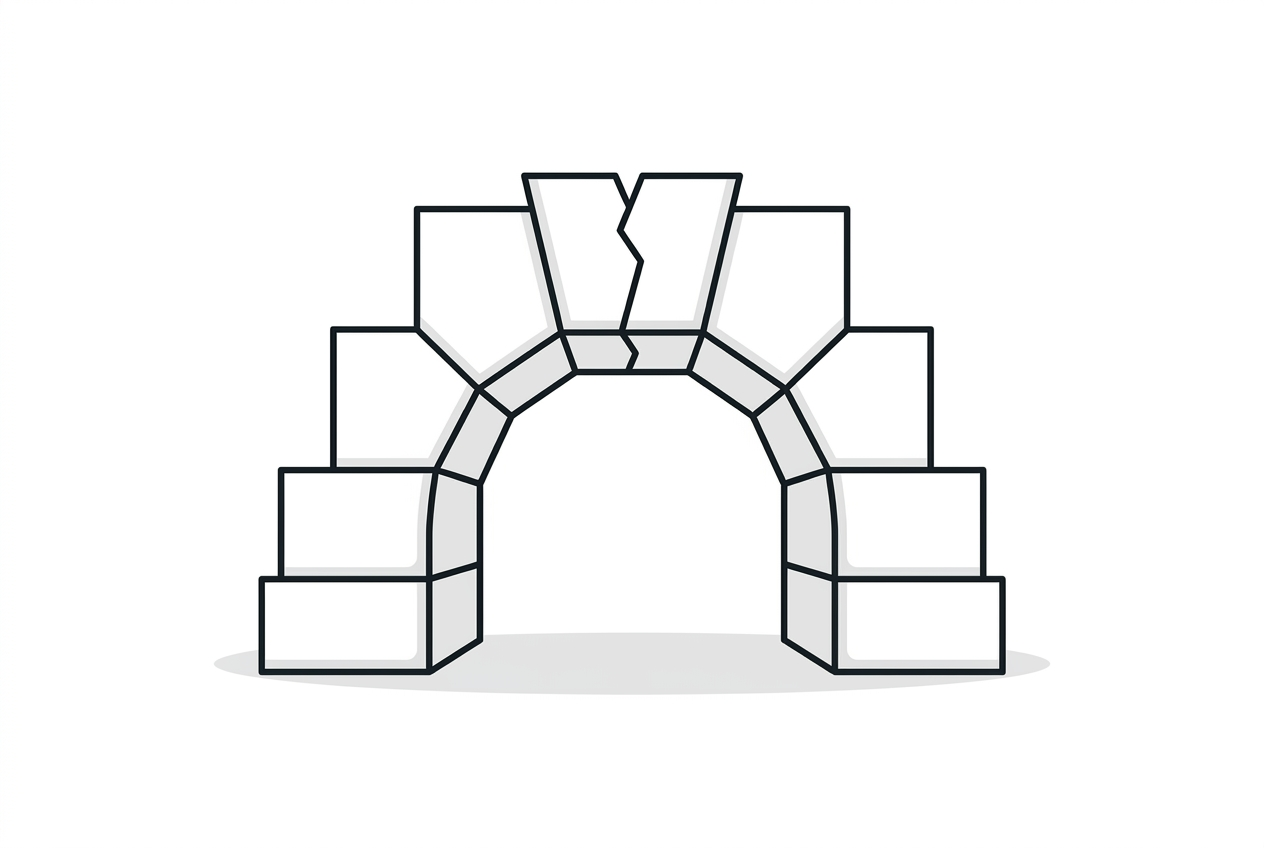
"Looking ahead, what kind of new world order do you envision?" the interviewer asks. Branko Milanovic replies: "We clearly have a global disorder."
Notice what he refuses to do. He is asked to name a new order, and he answers by naming its absence.
There is no design here to decode, he seems to say. The question smuggled in a premise—that behind the wreckage lies an architecture—and the honest economist declined to supply one.
I want to take that refusal seriously, because most of the smartest writing about our moment does the opposite. It refuses to refuse. It insists on architecture.
Consider the convergence, which is genuinely impressive. From four different disciplines, the same sentence keeps arriving in slightly different clothes.
Daron Acemoglu has just published an ambitious book on why liberalism became, in what is presented as the framing of the piece, "a victim of its own success." A real diagnosis, he tells Yascha Mounk, "requires both a recognition of the proximate causes of the crisis, but also the ultimate or the fundamental causes that underpin those proximate causes."
Note the ambition in that word "fundamental." He is not content with what broke; he wants the deep law that made breaking inevitable.
In Foreign Affairs, four scholars, all of whom are political scientists or international relations scholars, title their diagnosis "Liberalism Doomed the Liberal International Order." The postwar order decayed, they argue, "because what many saw as its greatest strength—how its institutions, norms, and rules were grounded in liberal principles—was actually a source of weakness."
The very grounding was the flaw. Rigidity was baked into virtue.
In International Organization, an entire 2021 special issue asks how the order challenges itself. One article names the mechanism precisely: "self-undermining feedback effects," defined as "mechanisms through which institutional arrangements undermine their own political conditions of survival over time."
Illiberal states, the authors show, "converted norms of openness into a vector of attack." Openness was the wound the order cut in itself.
A companion piece describes the order being "hollowed out from within" by a "merger of its discontents"—populists in the Western core and authoritarians on the semiperiphery, "digitally, ideologically, and organizationally interconnected," amplifying each other.
The shape repeats. Success generates the antibodies that kill it. Strength is weakness in a slow-release capsule.
You can see why the story is irresistible. It is tragic in the Greek sense—the fatal flaw seeded in the founding gift—and tragedy flatters us with a sense of depth.
But here is where I want to slow down, because one member of this school is honest about the trap.
Laurence Whitehead, writing on the "upsurge, overreach and unravelling" of the liberal order, does something the others do not. He steps back and names the genre.
He treats the whole idea of a liberal international order as "a discursive metanarrative"—an overarching frame that lets its users "find macro-historical patterns" in "the complex and bewildering flow of global political configurations."
And then he tells us the price of that convenience. Such metanarratives, he writes, "stand at one remove from the historical patterns that they claim to capture," and therefore "they are not directly falsifiable."
Read that admission twice. The frame is not the kind of thing that evidence can refute.
Instead, Whitehead says, metanarratives "periodically gain such traction that they appear beyond question, but also retreat and fade" when failings accumulate—"without completely imploding." They do not die of counterevidence. They go out of fashion.
Now turn that scalpel back on the convergence itself. "Success breeds crisis." "The order undermined its own conditions of survival." These sentences have the same structure Whitehead is describing.
They are elegant. They are unifying. And they are almost impossible to falsify—because any outcome confirms them.
If the order collapses, its strengths were secretly weaknesses. If it survives, its self-undermining tendencies were merely contained. The theory eats every result.
This is the quiet problem with "victim of its own success." It is a shape that fits any success and any failure, because it defines the failure as a downstream property of the success. What could the world have done to prove it wrong?
It is a shape that fits any success and any failure, because it defines the failure as a downstream property of the success. What could the world have done to prove it wrong?
I am not saying the disorder is imagined. Milanovic's flat refusal is the opposite of denial—it is the acknowledgment that the wreckage is real and that no tidy blueprint sits underneath it.
Whitehead himself catalogs the concrete breakage: security alliances breaking, trade commitments overturned, migration patterns "drastically reconfigured," public discourse "unanchored." The Chatham House research paper calls the order "more fractured now than at any point since the end of the Cold War."
The fragmentation is a fact. What I am questioning is the second move—the leap from fracture to fate, from "this broke" to "this had to break, from the inside, by its own logic."
Because that leap does specific work for us. If doom was structural, then the diplomacy that might have prevented it was always futile, and the diplomacy that might now rebuild is equally beside the point. Built-in doom excuses us from the boring labor of repair.
Here is a different epistemology, and it comes from an unglamorous profession. Diplomats, Abi Olvera writes, do not optimize for the dramatic or the negative the way journalism does. They optimize for "small, measured, and accurate updates."
The diplomat's goal, she says, is "to build a correct, if boring, model of the world, continuously update it, and prepare decision-makers to hold to that model with the right level of confidence."
Boring. Incremental. Correctable. This is the exact opposite of the metanarrative, which is thrilling, total, and immune to update.
The metanarrative is a view from 30,000 feet, where individual choices blur into a single downward curve. The diplomat's view is at ground level, where the next update is always possible and nothing is yet a curve.
And this is where Bruno Maçães sharpens the point into something almost psychological. He borrows Carl Jung's account of the insecure ego, which "projects the traits they repress or reject in themselves onto others."
Those others become "convenient repositories of everything evil and ugly in the human personality." World politics then "becomes a final confrontation between good and evil." And the punchline: "The monsters we confront are the monsters we ourselves have created."
Maçães applies this to the national ego, but it applies just as well to our theories of it. A self-undermining metanarrative is a kind of projection—the order casting its future collapse as an inner monster it was always fated to birth.
Against this dualism he sets the Indian tradition of Advaita, nondualism, which treats "the opposition between ego and other" as belonging to "the lowest level of consciousness." Order, in this reading, "can never be based on power" but grows "from the effort to detach ourselves from power."
I do not need the metaphysics to keep the insight. Fragmentation, on this view, is neither pure accident nor pure destiny. It is a habit of perception—a way of carving the world into fated forces—that we could choose to update.
Maçães is honest that the habit is sticky. India, home to Advaita, reportedly tested "Smiling Buddha" in 1974 and "Operation Shakti" in 1998, and Pakistan answered within the year. The nondual insight did not stop the mimetic rivalry.
So this is not a promise that better perception dissolves conflict. It is a smaller, more diplomatic claim: that the story of built-in doom is one update we are entitled to revise.
Milanovic was right to refuse the question as posed. There is no new order to name, and no hidden design in the disorder either.
But between "no design" and "designed to fail" lies the whole terrain of contingent, buildable order—the terrain the metanarrative skips because it is boring, and unheroic, and made of small corrections rather than tragic laws.
The convergence is too elegant. Elegance is doing work that evidence should. And the least comforting possibility is also the most demanding one: that the order did not have to break, which means someone still has to do the slow work of putting it back together.