There is a contradiction sitting at the center of the attention crisis, and almost no one names it.
On one side, the diagnosis has never been more structural. On the other, the remedy has never been more private.
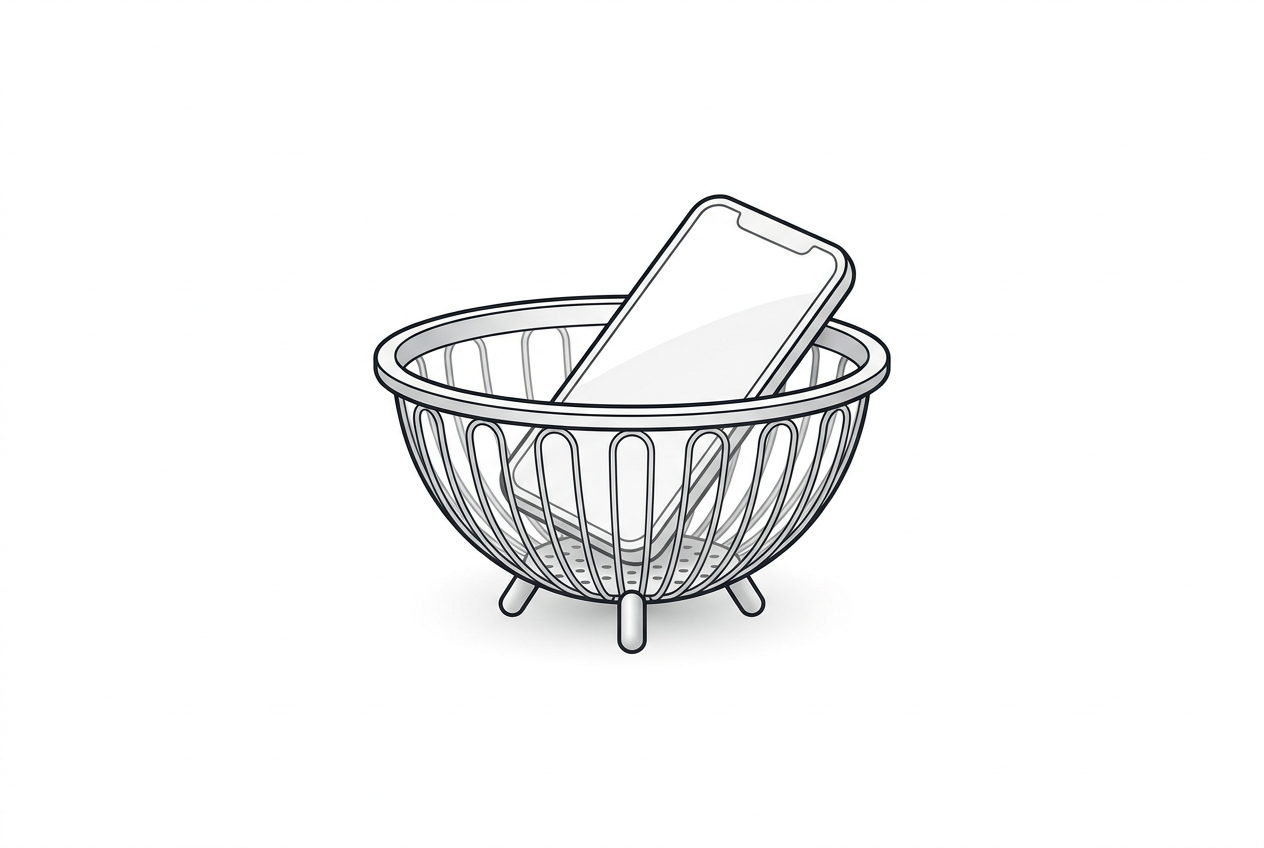
Consider the scene. More than a dozen millennials gather in a Brooklyn brownstone and place their phones in a metal colander, then spend two hours reading, drawing, talking — anything but staring at screens.
A few miles away, in a converted cardboard-box factory, nearly twenty people in their thirties stare at their phones for a minute, set them down, and look at their bared palms. Then their neighbors' palms.
Take the longing seriously, because it is real. Anyone who has watched an evening dissolve into a scroll they did not choose knows the ache these people are trying to answer.
But pose the quiet question the colander cannot: what, exactly, does dropping your phone into a bowl change about the machine on the other side of the screen?
Last week in these pages we asked whether a text could still be trusted to mean what it says — reading as a problem of credibility. This week the question moves outward, from the trustworthiness of the page to reading as a public capacity, and to who owns the mechanism now trained against it.
Because the people building the colander clubs are not confused about the mechanism. They describe it precisely.
The Friends of Attention, a collective that formed after the 2018 São Paulo biennial, have published a manifesto arguing that it is now, they say, "all but impossible to want what you want to want."
That is a strong claim, and a structural one. It says the corruption reaches past behavior into desire itself.
D. Graham Burnett, a historian of science and one of the group's members, puts it plainly: "This is not: 'Don't worry, capitalism is going to give you five different kinds of toothpaste.' This is the opposite. Less free, less choice."
He and Loh reportedly speak from their home, a penthouse in uptown Manhattan, with a five-week-old baby in the next room.
I flag the address not to sneer but to mark the gap. If desire itself has been captured — if the machine reaches into the wanting — then a manifesto and a phone-free focus group are curiously undersized weapons.
You reach for willpower when you have no lever. That is the whole story compressed into a sentence.
The colander is what resistance looks like when you cannot touch the thing you are resisting. It relocates a structural extraction problem into the register of personal discipline, where the affluent can afford to practice it two hours at a time.
The colander is what resistance looks like when you cannot touch the thing you are resisting. It relocates a structural extraction problem into the register of personal discipline.
To see why that is a category error, look at the one place the levers are being pulled — and the one place they are conspicuously not.
Platforms can be understood along three separable axes: what content circulates, how it is algorithmically amplified, and who owns the infrastructure doing the amplifying. Only the second axis is the engine of the attention economy — the ranking of content by its capacity to hold you rather than by its truth or its worth.
Within the first seven months of 2026, three powers each grabbed a different lever. The United States acted on ownership, forcing ByteDance to divest TikTok's American operations into a joint venture roughly four-fifths American-owned, led by Oracle, Silver Lake, and MGX — a fix that changes who owns a foreign platform without touching how any platform allocates attention.
The European Union acted on design. In July 2026 the European Commission found that Instagram and Facebook's infinite scroll, autoplay, and personalized recommendations breach the Digital Services Act by design, exposing Meta to a fine of up to six percent of global turnover.
Read that finding slowly. It does not ask who owns the algorithm. It asks how the algorithm is built, and rules the construction itself unlawful.
That is the closest any jurisdiction has come to regulating the mechanism — the amplification engine — as the phenomenon it actually is. Brussels did not ask its citizens to muster cognitive patience. It declared the design a violation.
China, for its part, dissolves the three axes into one: domestic platforms, mandatory state-reviewed algorithm registration, and a firewall that filters content before amplification is even a question.
Now set India beside all of them, because India is the case that proves the point.
Between 2014 and 2024, India added more internet users than live in the United States today, per DataReportal 2024. Its citizens are now, per DataReportal 2024, the single largest national user base anywhere for WhatsApp, YouTube, and Instagram.
India is, in other words, on one reading the world's largest supplier of the raw material — human attention — that the entire industry converts into revenue.
And yet, alone among the major digital powers, India has legislated almost exclusively on the first axis: content. It regulates what circulates while the amplification assets, and the ownership of them, sit outside its reach.
This is the asymmetry worth calling by its name. The country with the largest stake in the attention economy has moved hardest on the one lever that leaves the value-generating machinery untouched.
If the largest supplier of attention on earth cannot reach the amplification engine, what precisely is a Brooklyn colander supposed to accomplish?
The two scenes are not equivalents at different scales. They are the same mistake — willpower substituting for governance — performed once by a state and once by a dinner party.
The individual remedy is not merely insufficient. It is a private good that quietly concedes the public fight, available to those with the leisure and the real-estate to opt out for an afternoon.
Which brings us to what we are actually defending, and why the defense has to be specified with care.
The thing at stake has a name. Maryanne Wolf reportedly calls it deep reading: engaging an extended text so as to anticipate its direction, to bring what you already know into dialectic with the page, until writer and reader fuse and something new is thought.
Its value is not sentimental. Deep reading generates insight — and in an age where information is infinite but insight is scarce, the capacity to produce understanding rather than merely retrieve data is exactly the civic muscle worth protecting.
But here is the uncomfortable corollary, and the essay would be dishonest to skip it.
"Deep reading" curdles fast into a class and generational shibboleth if we refuse to say what we mean by it.
Writing on Daily Kos, a reader pushes back on the familiar lament that long, hard books are the only path to complex thought. She watches her nine-year-old and his friends debate building materials, structural loads, and the chemistry of combining elements — knowledge they absorbed from anime.
They sustain multi-year fictional universes, write fan fiction, argue that a katana cannot appear in a given world because it postdates the setting. That is patience. That is attention. That is a reader anticipating an author's direction and testing it against what he already knows.
If deep reading is a neurophysiological capacity — the ability to hold sustained, structured attention on a complex system and think inside it — then it is not the property of the nineteenth-century novel, and defending it cannot mean defending our own childhood syllabus against theirs.
The distinction matters because the two errors reinforce each other. Treat deep reading as a private virtue and you get the colander: a discipline the comfortable perform on themselves. Treat it as a fixed canon and you get the professor mourning that students no longer read what he read.
Both mistakes locate the problem in the individual — his willpower, her taste — and leave the amplification engine humming untouched.
The honest position is narrower and harder. What deserves defending is a capacity, not a reading list. And a capacity under systematic assault by a machine engineered to fragment it will not be saved by asking its victims to try harder.
It will be saved, if at all, the way Brussels started to save it: by ruling that infinite scroll is unlawful by design, that the mechanism itself is the harm, that the question is who builds the thing and how — not whether you can resist it on a good night.
The colander answers a real ache with a false lever. Keep the ache. It is telling you something true about the machine.
Then put the phone back in your pocket and ask the only question that scales: who owns it, who designed it, and which government has the nerve to touch the second axis.
That is not a discipline you can practice alone in a brownstone. It is a fight, and it is the fight.