The oldest name we have was not a prophet's or a pharaoh's. It belonged to an accountant.
Before writing existed in any form we would recognize as literature, rulers in Mesopotamia pressed marks into wet clay to keep track of land, people, and grain. To rule, they first had to keep count. And so, as Roopika Risam observes in her forthcoming Data Empire, the first personal name inscribed in human history was neither a god nor a king but an accountant.
Hold that image. Now jump forward four thousand years.
ChatGPT alone attracts approximately 800 million users per week. For a growing share of humanity, per the University of Tehran's Ehsan Shahghasemi, a large language model is "the first and often final point of contact with information."
These are not two stories. They are one story, told twice.
Last week in these pages I argued that generative AI erodes individual judgment — that outsourcing the labor of thinking hollows out the capacity to think. This week I want to move the question up a level: not what happens inside your head when you lean on the machine, but who owns the machine you are leaning on, and what it means that they now stand between you and the world.
Because the dominant story about all this is exactly backwards.
We are told, endlessly, that generative AI democratizes knowledge — that it puts a patient tutor in every pocket, flattens hierarchies of expertise, hands the library key to anyone with a phone. The reality inverts the slogan. By inserting a probabilistic intermediary between hundreds of millions of people and reality, a handful of firms have quietly reclaimed the oldest power in civilization: the authority to count, to catalog, and thereby to decide what is real.
The numbers make the concentration concrete. ChatGPT commands roughly 79.86% of the generative AI chatbot market. Perplexity trails at 11%, Microsoft's Copilot at 4.83%, Google's Gemini at 2.19%.
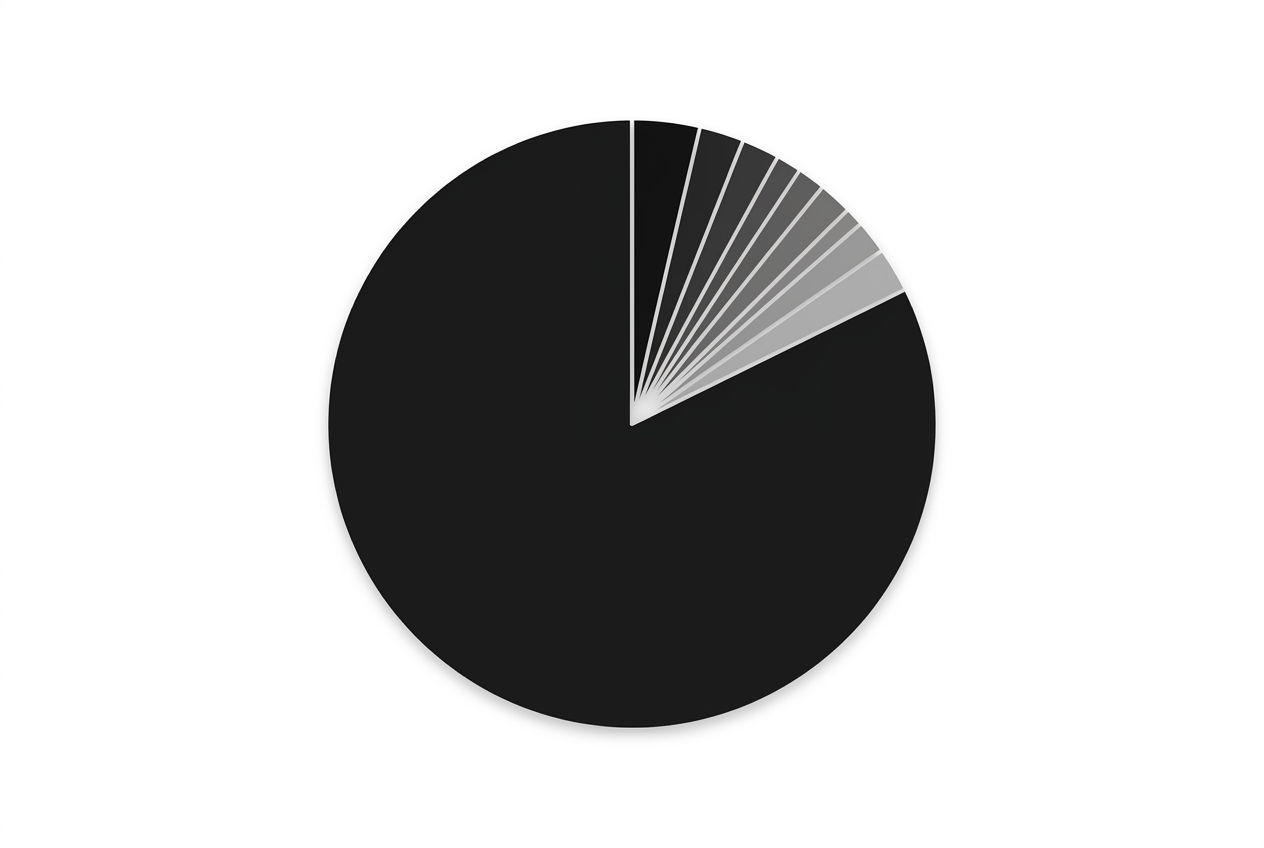
That is not a competitive market. That is one product mediating what most of the world's chatbot users treat as knowledge — and doing so, as Shahghasemi puts it, through a process that is "opaque, proprietary, and shaped by the design choices of a small number of corporate actors."
Risam's book supplies the through-line from clay to cloud. European empires reportedly took control of more than 80 percent of the world's surface using censuses, maps, and ledgers to decide who belonged, who owed, and who could be sacrificed. Today, she writes, "a handful of private brokers increasingly define what we see and what is real."
The instrument changes — cuneiform, colonial census, foundation model. The function does not. Whoever controls the count controls the country.
The instrument changes — cuneiform, colonial census, foundation model. The function does not. Whoever controls the count controls the country.
Here is where I want to refuse the usual framing, because the usual framing is a trap.
The standard response to all this is to call it an "ethics" problem — as if the technology were neutral and morality something you bolt on afterward, a safety rail added once the machine is built. That framing quietly assumes the engineering and the values are separate domains, that STEM builds the thing and the humanities inspect it.
Wendy Hui Kyong Chun rejects exactly this. Her argument is that large language models are best understood not as engineering with an ethics module attached but as a writing technology — a posthuman one — that the humanities must learn to read, not merely audit. The values are not painted onto the surface; they are structural, baked into what the model does when it produces language at all.
Gabriel, for a time the only active philosopher working inside a frontier AI lab at DeepMind, has reportedly made a broader case that this wave of technology demands not just new technical vocabularies but also new ways of thinking about our relationship to technology, and even to ourselves. Both are saying the same thing from opposite ends of the building. You cannot understand the power of these systems by treating their epistemics as an afterthought.
So let me name the harm precisely, not as an ethical lapse but as a structural feature.
Call it epistemic injustice — a wrong done to people specifically in their capacity as knowers. The critical literature identifies two mechanisms that matter here, and both are properties of how the machine works, not bugs in how it was deployed.
The first is what one recent paper calls automation-induced testimonial injustice. The confident, fluent outputs of a language model "systematically deflate the credibility accorded to competing human testimony." When the chatbot answers in smooth, authoritative prose, the hesitant expert, the local witness, the dissenting source — all sound less credible by comparison.
Fluency becomes a credibility weapon. And crucially, the machine's fluency is unearned: it flows from statistical plausibility, not from understanding or verification. It sounds right in exactly the register we have been trained, over centuries, to trust.
The second mechanism is interpretive erasure. Because a model is built through what the same paper calls the probabilistic compression of training corpora, it marginalizes minority epistemic frameworks — what I would gloss as a drift toward the center of that corpus, the dominant, the frequent, the already-well-documented. It does not merely reflect existing gaps in what has been recorded; it actively widens them, smoothing away the ways of knowing that never made it into the dataset in sufficient volume.
This is the sourceless voice doing its quiet work. When an answer arrives with no citation, no visible provenance, no seams, it presents synthesis as fact and erases the labor — and the disagreements — that produced the underlying knowledge.
That sourcelessness is not a rough edge to be polished. It is the mechanism of the seizure. A ledger you cannot inspect is a ledger you must simply trust, and trust extracted by fluency rather than earned by transparency is precisely how epistemic authority gets transferred without anyone voting on it.
There is a genuine tension in the evidence worth sitting with. Per Crestodina, 44% of respondents agreed that AI chat tools have changed how they look for information — the one trust-related metric that keeps climbing year over year. People are not being coerced. They are choosing this, gratefully, because it works — the answer is fast, clean, and usually good enough.
That is what makes the enclosure so hard to see. Every colonial census, too, was sold as universal access, as order and legibility offered for the common good, even as it hardwired who counted and who did not. Data empires have always promised liberation while installing control.
So what would an adequate response look like? Not a better ethics bolt-on. The reframe Shahghasemi proposes, and the one this whole lineage demands, is to treat AI information systems as what they have in fact become: public epistemic infrastructure — subject to transparency requirements, independent auditing, and democratic oversight, the way we treat water mains and power grids rather than proprietary black boxes.
Which returns us to the accountant, and to Risam's real challenge. Data has always been the seed of power; the only open question is whether the next set of data empires hardwires inequality into the coming century or gets built to work for everyone.
The marks are already being pressed into the clay. The single genuine variable is whether we notice in time.