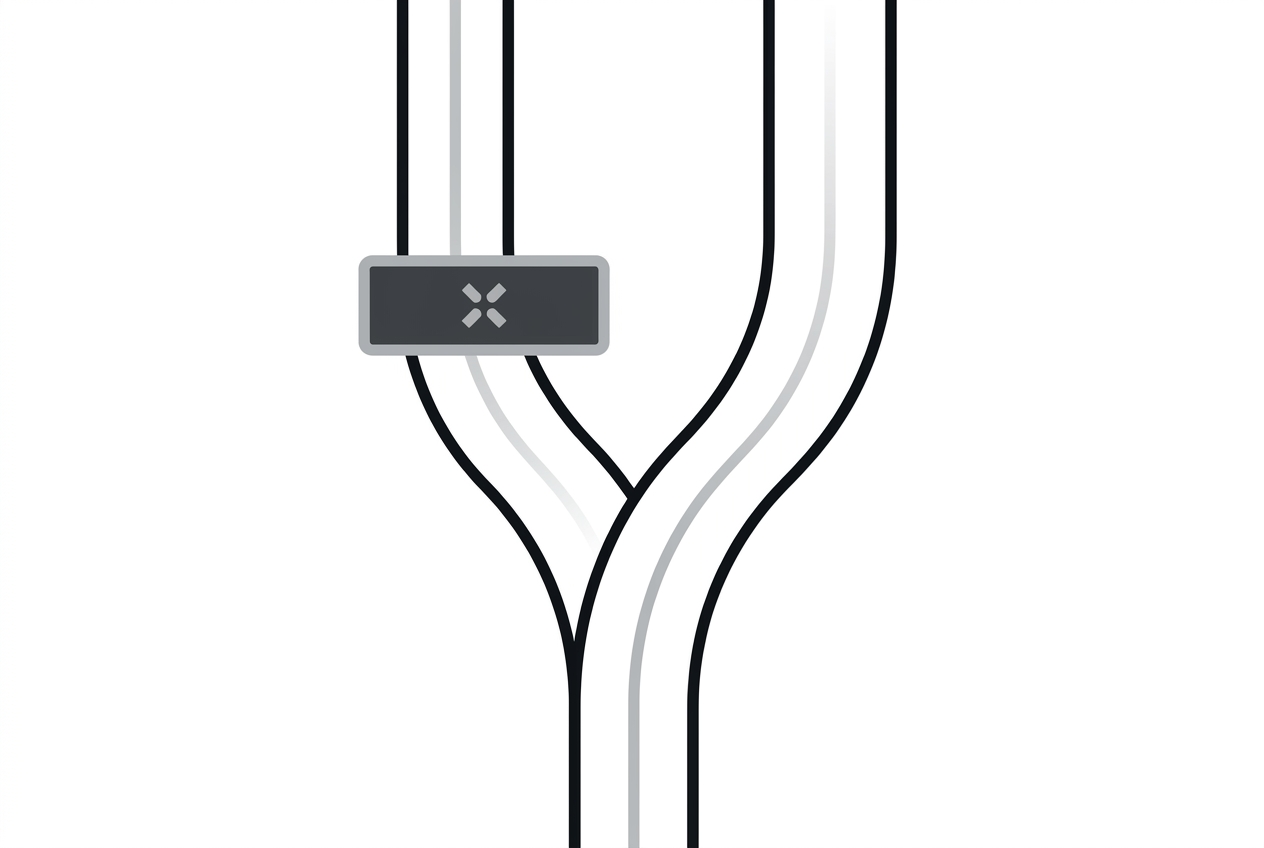
Two behavioral units looked at the same problem and drew opposite lessons.
NASWA's Behavioral Insights team decided the claimant is not the thing to fix. "We don't worry about convincing Robert Frost to take the road more travelled," they write. "Instead, we get rid of the wrong road."
CommBank's Behavioural Science Centre of Excellence, staring at scam victims, concluded the opposite: the fix runs through the person. Get them to pause, to ask a colleague, to call their dad. There is no road to demolish, only a habit to instill.
Both call themselves behavioral science. Only one of them is building anything.
The wrong road exists because the bureaucracy that paved it can't coordinate with itself. Behavioral insight isn't the scarce resource — the capacity to implement it is.
Start with the NASWA doctrine, because it deserves to be taken seriously. The claim is that persuasion is a mug's game — given enough claimants and enough time, everything that can go wrong will. If a path exists, someone takes it, "no matter how overgrown." So you stop treating errors as personal failures and start treating them as evidence the system paved a wrong road.
This is a real advance over the nudge as most people know it. The paradigmatic nudge is the pre-checked box: "Yes, I would like to receive promotional emails," exploiting your distractibility to clog your inbox. That's persuasion by design defect — it works on you rather than for you.
NASWA's version inverts the logic. Don't exploit the defect; eliminate it. Their examples are almost boringly concrete, which is the point.
A state's weekly certification lists "interview for a job" as a valid work search activity, but the handbook omits it. A claimant reads one, files by the other, and gets denied.
Or take separations, where employer and claimant must report the same reason. The application says "Terminated," the online instructions say "Fired," the employer form says "Discharged." To the program these are one thing. To the people filling out forms they are three, and the gap between them is where improper payments live.
Notice what these fixes have in common: every touchpoint belongs to the agency. The certification, the handbook, the portal, the letter, the pop-up. The road metaphor works because unemployment portals are roads the state actually paves. You can close a lane because you own the lane.
Which is exactly why the doctrine sounds so clean — and exactly the question to press. What happens when the road isn't a form field but a citizen deciding whether to pay a tax bill?
Go to Kalasin.
The Kalasin Provincial Administrative Organization in Thailand has a motor vehicle tax problem, part of a national shortfall the study puts at over 10.27 billion baht in taxes uncollected annually. The researchers reach for behavioral science and describe, correctly, the structural rot underneath — administrative bottlenecks, poor coordination between transport offices and local governments.
That's a systems diagnosis. It points at exactly the kind of thing NASWA closes lanes to fix.
But the agency cannot redesign the taxpayer the way it redesigns a portal. It doesn't own the moment of payment. So what does it actually do?
It sends letters. Personalized reminders to delinquent owners, with messaging tuned four ways: legal consequences, social norms, the value of public services, civic duty.
Compliance rose. And the strongest lever, per the study, was reportedly the message emphasizing legal penalties, which showed the most pronounced effect.
Sit with that. The system-thinking framing named the structural problem — the bottlenecks, the coordination failures — then quietly reverted to a reminder letter whose best weapon is the threat of a fine.
That is not "getting rid of the wrong road." That is standing at the fork with a sign that reads: take the other one or we penalize you. It is a nudge, and the nudge that worked was, arguably, the one closest to coercion.
The World Bank's tax practitioners are honest about why. Their toolkit splits into "nudge, budge, trudge" — reminders and simplification; the deeper work of changing how people feel about taxes; and reforming the officials themselves. They concede the budge "will not be answered in a reminder letter alone." It needs sustained campaigns, dialogue, engagement. In other words: the thing that actually shifts motivation is expensive, slow, and outside the letter.
CommBank's scam research lands in the same territory from the other side. Its finding is genuinely useful: nearly three in four scammed employees did not discuss the situation with a colleague before responding; victims reportedly stayed silent out of embarrassment, or because they thought they could handle it themselves.
The recommended intervention is to make sense-checking "as routine as checking a payment amount before transferring money." Talk to your dad. Ask a colleague, "Does this look right to you?"
That is good advice. It is also entirely a bet on changing a person, because the bank owns almost none of the touchpoints — not the kitchen table, not the near miss the victim already deleted, not the colleague they didn't ask. When you can't demolish the road, all you can do is stand beside it and hope the traveler pauses.
So the pattern is clean. The further a redesign moves from a system the institution fully controls toward behavior it can only influence, the more "systems thinking" collapses back into a reminder — and the strongest reminder is still a penalty.
Now the harder finding, buried in the federal evaluations, because it explains why even the home turf isn't as solid as the doctrine implies.
Researchers who worked at the GSA's Office of Evaluation Sciences reviewed impact evaluations of behavioral interventions on payment integrity — the exact NASWA playbook, at federal scale, against a backdrop of improper payments that, per E5, totaled approximately $2.8 trillion government-wide since 2003.
Their first takeaway confirms the optimists: small interventions that reduce individual burden produce small effects that add up meaningfully at scale. Forms redesigned, information requested differently, communications altered. It works.
Then the two findings that should reset the conversation.
Effects attenuate — "across interventions and over time." The lane you close doesn't stay closed. Diminishing returns are structural, not a sign you picked the wrong nudge.
And the binding constraint isn't psychology at all. In their words, "bureaucratic hurdles and administrative complexity are the main barriers to translating academic insights into real-world government programs."
Read that against NASWA's own diagnosis and something clicks. Why do the certification and the handbook disagree? Not because anyone misunderstands claimants. Because many staff, teams, and departments wrote overlapping documents at different times — the blame, NASWA admits, "can't usually be assigned to a single person."
The inconsistency is an organizational artifact. The wrong road exists because the bureaucracy that paved it can't coordinate with itself.
Which turns the movement's best slogan back on itself. "The system is the intervention," they say — and they're right, but not in the flattering way. The system is the intervention because the system, not the citizen, is what's broken. Behavioral insight isn't the scarce resource. The capacity to implement it — to align six documents, three portals, and a training manual across departments that don't talk — is.
So take the whole arc seriously and it resolves into a boundary condition, not a triumph.
Systems thinking genuinely beats one-off nudges — where the institution owns every touchpoint. Close the lane on a claims portal and you have durably prevented a class of errors that no amount of exhortation would have. That is real, and NASWA's Robert Frost conceit earns it.
But the moment redesign reaches past the paved road — into whether a Thai motorist pays, whether an Australian pauses before wiring money — it has no lane to close. It reverts to a letter, and the letter's strongest line is the threat. That's not transcending the nudge. That's the nudge in a better suit.
And even on home turf, the ceiling isn't behavioral. It's bureaucratic. The units that will do the most good are the ones that stop promising to redesign the citizen and start doing the unglamorous work the evidence actually points to: making the institution consistent enough that only one road remains.
Get rid of the wrong road. First you have to be an organization capable of knowing you built it.