
Here is the most reliable finding in the science of talking to strangers, and it is almost aggressively boring: people brace for awkwardness that does not come.
Nicholas Epley has run this study in enough variations that the result behaves like a law. Before the conversation, people forecast stiffness, rejection, a stranger who turns out to be a jerk. After, they report the opposite.
The gap between prediction and outcome is the whole story. It is not shyness, and it is not bad luck. It is an estimate that is wrong in a consistent, knowable direction.
That consistency is the good news. A trait you lack is hard to fix. A forecast you keep botching the same way is a correctable error, the way you can learn to add nine to a number and stop landing one short.
A trait you lack is hard to fix. A forecast you keep botching the same way is a correctable error.
So the interesting question is not "why are people lonely." It is "why is the prediction biased, and biased in that specific direction."
Epley's answer is a mismatch in what each side is scoring. "Failing to realize that we look at ourselves through a lens of competence while others are evaluating our warmth can leave us underestimating just how positive reaching out can make others feel," he writes.
Sit with the asymmetry. Before you speak to someone, you audit your own competence—will I be interesting, will I say the right thing, will this land.
The other person is not running that audit on you. They are reading warmth: did this person approach me in a friendly, interested way. And warmth is the thing we grant first, before we know whether someone is competent, because we assume a likable person can be trusted.
You are being graded on a metric you are not even worried about, and worrying instead about one that barely counts in the moment. That is why the forecast tilts pessimistic. You are pricing the wrong risk.
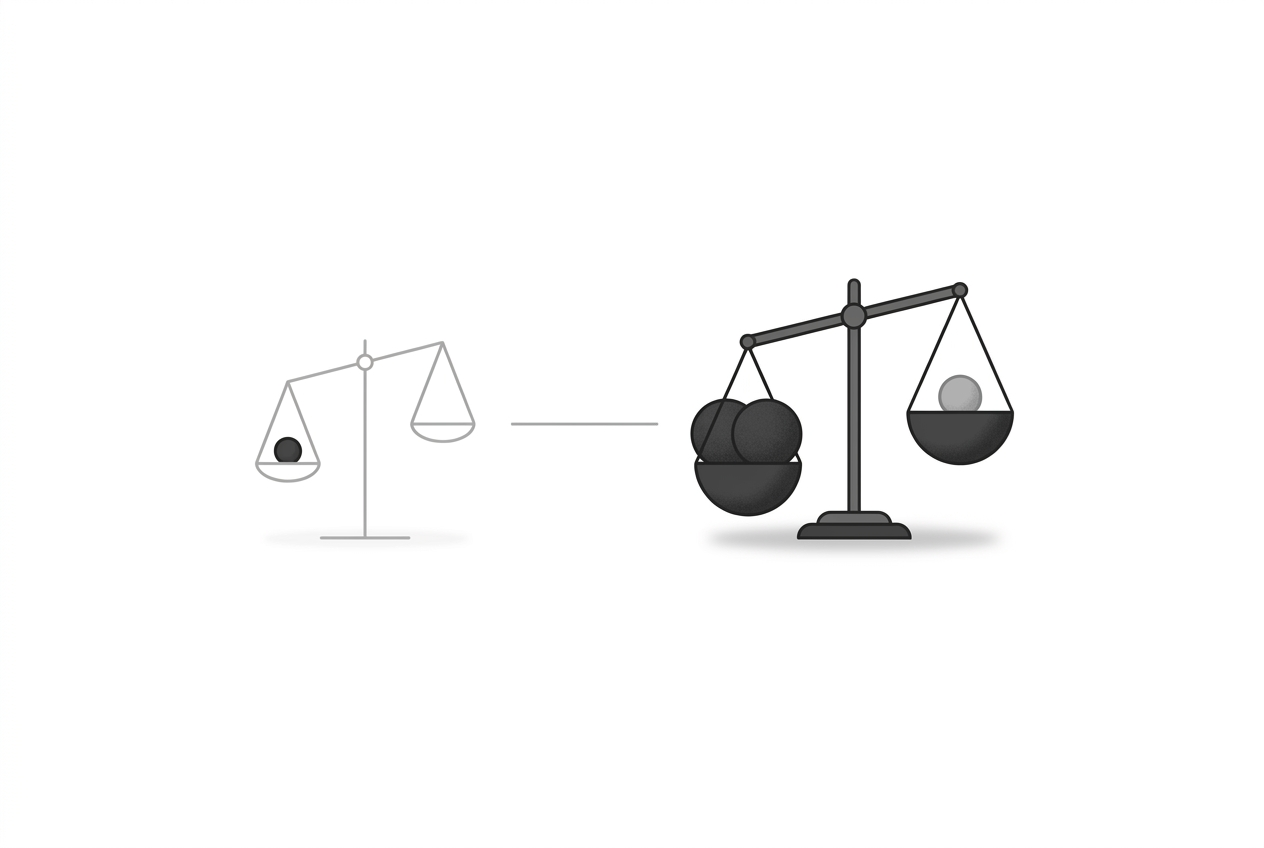
The second mechanism makes the outcome even more predictable than it feels. Humans are primed for reciprocity—we respond to people roughly the way they respond to us.
As Epley puts it, a social exchange tends to end consistent with how it began: treat someone like a friend and they reach back like a friend; treat them like a stranger and ignore them, and they ignore you right back.
Which means the opening move you dread is also, largely, the move that determines the result. You are forecasting a coin flip when you are holding most of the weight.
Now the trap closes. If your pessimistic forecast decides who you talk to, it also decides which data you ever collect.
"When your beliefs about how others might respond are guiding your decisions about whom to reach out to and whom to avoid, then they're also constraining the data in ways that make it a confusing source to learn from," Epley writes.
You avoid the encounters you expect to go badly. So you never run the experiment that would prove you wrong. The error is self-sealing—your caution deletes the evidence that would fix your caution.
This is why the fix has to be behavioral, not attitudinal. You cannot, reportedly, reason your way out of a belief that has been engineered to never meet counterevidence. You have to force the counterevidence—reach out on purpose, treat it as a test, and watch how often the awkwardness fails to arrive.
The costs here are not abstract. The mispricing shows up in the medium we choose, and the medium is worse than we think.
In one of Epley's studies, people connected with friends and with strangers by text, email, or voice. Voice-based contact—phone and video—made people feel more connected, with both friends and strangers, "despite their expectations to the contrary."
That last clause is the entire problem in four words. We want closeness, we reach for text, and we are surprised that voice would have delivered more. Writing strips out the emotional tone and the instant feedback that talking gives you—the synchrony and the sound of a human voice that make an interaction land.
So we default to the channel that feels easy and connects less, then conclude that reaching out is not worth it. We ran the experiment badly and blamed the finding.
The same forecasting error scales up to the encounters that look hardest: talking across a difference. And it fails there too, in ways people find genuinely surprising after the fact.
Take the pharmacy students at Samford's McWhorter School, assigned to spend an hour immersed in a culture not their own—alone, off their phones, no friend for cover. One student went to a Black church, reportedly worried their presence might be disrespectful.
The reflection afterward: "all my anxiety about being in a different cultural setting was my own issue," and, "my initial fears had been unnecessary." Welcomed, not tolerated. The dread was internally generated and externally unconfirmed.
That is the affective-forecasting gap in miniature: the fear was real, vivid, and specific, and it described the forecaster, not the room.
Watch it happen with kids, too. A group of California eighth graders in Washington, D.C., were, per E3, initially nervous to meet unfamiliar teens from places like Kansas and Louisiana—lives they imagined as alien to their own.
Days later, saying goodbye, they were nearly teary-eyed. The gap between the braced-for version and the lived one was, once again, enormous—and pointed the same direction it always does.
Note what these people are not: not unusually brave, not natural extroverts. They were nudged into running the experiment, and the experiment overturned the forecast. The trait framing was never the operative variable. The behavior was.
Which is the reframe worth keeping. Connection behaves like a health intervention we ration for a strange reason—not because it is scarce or expensive, but because we misprice it on both ends.
We overestimate the cost: the awkwardness, the rejection, the intrusion that mostly does not materialize. We underestimate the payoff: how good a warm approach makes the other person feel, how much a voice beats a text, how fast a stranger becomes teary-eyed at the goodbye.
Overprice the cost, underprice the return, and any rational person under-invests. The rationing is not a character flaw. It is a math error dressed up as prudence.
So stop treating outreach as a personality audit—am I the kind of person who does this—and start treating it as a bet where you already know the odds are better than they feel. Epley's own framing is telling: unlike punishing goals such as exercising more or eating better, becoming a little more social is "a surprisingly positive experience," even for introverts.
Practically, that means dosing it. Send the voice note instead of the text. Take the call. Say the thing to the person in line. Go to the unfamiliar room alone.
And then, crucially, log the result against the forecast—because the only way to recalibrate a biased predictor is to keep feeding it the outcomes it has been avoiding.
You are not short on courage. You are short on data, and you have been the one withholding it.