Fourteen million foldable iPhones by fiscal 2027. That's the number lighting up the AAPL bull case right now, and it comes from exactly one place: a single Redburn Atlantic note.
Hold onto that fact. We'll come back to it.
The reason we're talking about any of this is dull to the point of comedy. On Monday, Apple seeded the macOS Tahoe 26.7 release candidate to developers — a routine, near-final update — and the code quietly confirmed more than ten unreleased products the company never announces early.
Internal codenames, hardware identifiers, feature flags. A foldable iPhone. A new HomePod mini. A smart home hub with a screen. A security camera. Camera-equipped AirPods. A future Vision headset.
Apple is normally obsessive about scrubbing these references. This time it didn't, and the result is the clearest picture we've had of the company's fall lineup — and its biggest home push in years.
Last issue, we were tracking whether the foldable would even ship on schedule. This week the question has moved: the whole smart-home lineup has leaked, and the foldable's price has firmed up at roughly $2,200. So the buyer's question changes too.
Of everything in that code, two things actually matter to you. And they pull in opposite directions.
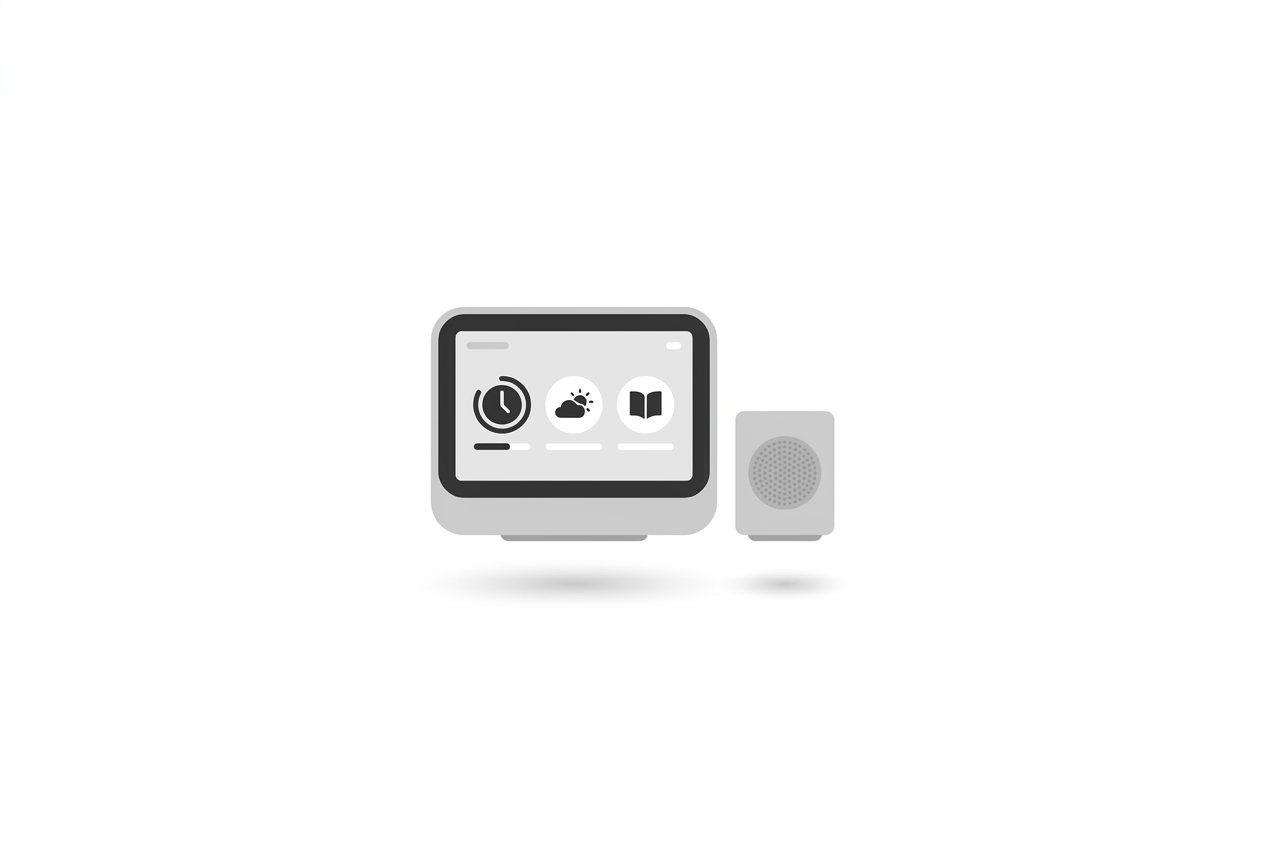
Start with the home gear, because it's the part most Apple users should genuinely consider. The leak points to a new smart hub — the media calls it the HomePad — carrying codenames J490 and J491: one version with a speaker base, one built to mount on a wall. Roughly a 7-inch square display, a StandBy-style dashboard, running a new homeOS.
Alongside it: a next-gen HomePod mini (codename B525, distinct from the current B520) and what looks like an Apple-made security camera (J229). Colors leaked too — Rose Pink, Silver, Space Gray, Starlight.
This is the mass-market stuff. Unlike a $3,500 headset or a $2,200 foldable, a smart display and a speaker are things ordinary people put in their kitchens. And Apple has real structural advantages here.
Most US smartphone owners carry iPhones, which means brand trust and ecosystem lock-in are already baked in. A HomePad would slot into an Apple household without the setup friction that plagues the fragmented smart-home space. Add the new generative-AI Siri expected this fall, and you have a device that could finally make Apple competitive with Alexa and Google Assistant in the room, not just on the phone.
Which is exactly why the rumored price is the problem.
The HomePad is expected to land around $350. Now look at what it's competing against. Google's Nest Hub sells for $100. Amazon's Echo Show 8 and Echo Hub both run about $180.
Apple would be asking two to three-and-a-half times the price of the incumbents for a first-generation product in a category consumers already treat as an impulse buy. A smart display is not an aspirational object. It's a thing you glance at to check the weather and start a timer.
There's a real risk here, and it has a name. Price a genuinely useful device high enough and it becomes a Vision Pro — a cool gadget most Apple users admire and never buy, relegated to the recesses of the mind.
Apple likes to think of itself as a premium company. But the people buying iPhones are also the average consumers, and the average consumer is not paying $300 to $500 for a kitchen screen when a perfectly good one costs $100.
If Apple wants to sell these in volume, it needs to compromise on features to hit a lower price. The honest advice for buyers is simple: this is the device to want — but wait for the price tag before you want it. If it's $350, the Nest Hub keeps looking smarter by the dollar.
Now the other pole. The foldable.
The macOS code lists the next iPhone family as V62 through V68, with V68 widely read as the foldable — the "iPhone Ultra." Rumors put it at a 7.8-inch inner OLED, a 5.5-inch cover screen, a crease Apple is desperate to hide, and a price starting north of $2,000. The firmed-up figure is $2,199.
Here's the reframe: don't treat the iPhone Ultra as a buying decision at all. It isn't one for you, and it may not really be one for Apple either.
Look at the volume math. A Chinese tech blogger reports Apple's initial inventory for China at around one million units. Ming-Chi Kuo pegs Q3 shipments — the launch quarter — at just 500,000 to 1 million.
Set that against the conventional iPhones shipping beside it: 20 to 22 million units of the iPhone 18 Pro and Pro Max in the same quarter. The foldable isn't a volume product. It's a rounding error next to the phones people actually buy.
So where does "14 million by 2027" come from? Back to that single note. Redburn Atlantic's Timm Schulze-Melander upgraded Apple to Buy with a $400 target, and his model assumes 14 million iPhone Ultra units in fiscal 2027 at $2,199.
Read the fine print. Only about 4 million of those replace conventional iPhone sales. The rest are incremental — new money at the very top of the range.
That's the tell. The Ultra's job isn't to sell in bulk. It's to sit above everything else and pull the entire lineup's average selling price upward.
You can already see the lever working. The iPhone 18 Pro Max is estimated to start at $1,399 — a $200, 16.7% jump over the current Pro Max. Put a $2,200 halo above that, and $1,399 stops looking expensive. It looks like the sensible choice.
That's the whole strategy. A $2,200 device that makes a $1,399 device feel reasonable is worth building even if barely anyone buys it. The foldable doesn't need to ship in the millions to earn its keep; it needs to exist, visibly, at the top of the menu.
A $2,200 device that makes a $1,399 device feel reasonable is worth building even if barely anyone buys it.
Which is why the "volume catalyst" framing is backwards. The real AAPL story here is price, not units — one broker's 14-million bridge sitting inside a forecast band that runs from roughly 8 million to 25 million across a handful of analysts who can't agree with each other. That's not a market expectation. That's a single model doing a lot of load-bearing work.
So the verdict splits cleanly along the same fault line the leak revealed.
The home gear — the HomePad, the new mini, the camera — is the stuff worth caring about, because it's the stuff you'd actually use. But hold your wallet until Apple shows the number. At $350 against a $100 Nest Hub, enthusiasm should cool fast.
The foldable is the opposite. It's fascinating, it's premium, it's the halo — and it is not for you. It's the tide meant to raise the floor under every iPhone Apple sells this fall.
Watch the Ultra. Don't buy it. And when the HomePad price leaks for real, that's the moment the smart-home story actually begins.