
Here is the thing everyone gets backwards about Google's July 16 announcements. The rebrand grabbed the headlines. The rebrand is the least important part.
Google renamed NotebookLM to Gemini Notebook, folding one of its most beloved tools into the mothership brand. TechTimes put it plainly: the new name "is not the substantive story."
The substantive story is smaller, quieter, and far more consequential. Google Search can now write to apps you don't own.
The substantive story is smaller, quieter, and far more consequential. Google Search can now write to apps you don't own.
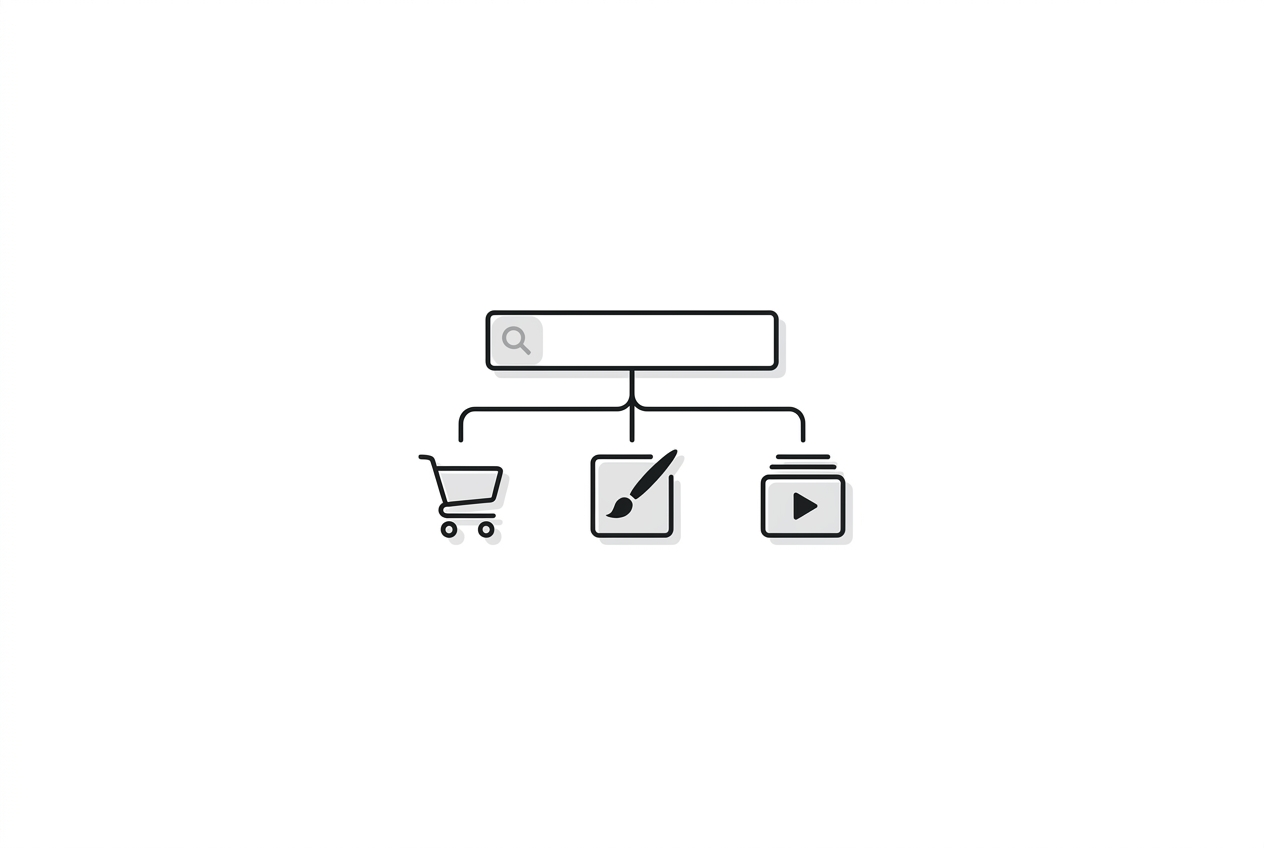
Start with what actually shipped this week. In the US, in English, AI Mode in Search can now connect to three launch partners: Instacart, Canva, and YouTube Music. Ask it to plan a barbecue, and it drops the ingredients into your Instacart cart, drafts a flyer in Canva, and builds a playlist it saves to YouTube Music before your guests arrive.
Notice the verbs. Drops. Drafts. Saves. These are not the verbs of a search engine.
For twenty-five years, Search did one thing: it handed you links and left the doing to you. This week it started doing.
That distinction — surfacing versus acting — is the whole story, and Google itself keeps drawing the line. When Personal Intelligence connected to Google Calendar, the company's own framing was telling: Calendar became "the first connected Google app that doesn't just provide context. It can actively act."
Gmail and Google Photos gave Search things to read. Calendar gave it something to write.
Robby Stein, Google's VP of Product for Search, offered the example. Ask for dinner recommendations, and AI Mode now knows you have an evening meeting scheduled, so it suggests something that fits the gap.
That is a small, almost banal feature. It is also a philosophical break with how Search has worked since 1998.
Here is the part that should stop you. For decades, typing the same query produced roughly the same results for everyone. That shared reality was the whole point of a search engine.
AI Mode is dismantling it. Calendar introduces what Google calls time awareness — two people asking an identical question can now get completely different answers because their schedules differ.
And this isn't theoretical. SEO research firm iPullRank found that simply connecting Gmail to Personal Intelligence changed which brands appeared in AI-generated responses, even with identical prompts across different accounts.
Think about what that means for anyone trying to verify a result. There is no canonical answer page anymore. There is your answer, shaped by your commitments, your inbox, your availability — signals that exist only inside your Google account.
You can no longer easily check the AI's homework against what your neighbor sees, because your neighbor sees something else.
Now the scale. This is not a fringe experiment. AI Mode crossed one billion monthly users just a year after launch, with queries more than doubling every quarter. Last quarter, Google says, total Search queries hit an all-time high.
So the personalization shift is landing on a product that a substantial fraction of the planet touches. Personal Intelligence has already expanded from AI Pro subscribers to nearly 200 countries and 98 languages.
Should you care? If you use Google Search — meaning, if you're a person with an internet connection — yes. The tool that has functioned as a neutral index is quietly becoming a personal agent that acts on your behalf and answers you differently than it answers anyone else.
Should you buy anything? That's where the picture gets muddier, because Google is running the same play across several products at once, and the good stuff is increasingly paywalled.
Take Gemini Notebook. The rebrand is free, but the actual upgrade — a dedicated cloud computing environment that writes and runs code against your uploaded material, plus a new reasoning engine and outputs like spreadsheets, slide decks, and data visualizations — launched in June for Ultra subscribers only.
This week, Google is finally extending that capability to AI Pro subscribers on the web, over the coming weeks. Free-tier users? Google "hasn't said when these capabilities will reach users on the free tier, if at all."
That last clause is worth sitting with. If at all.
The pattern repeats in Google Vids, where Gemini Omni now edits video through plain conversation — change the background, fix the lighting, add effects, no timeline scrubbing required. There are personal avatars too: upload a selfie and a voice clip, type a script, and a digital you delivers it on camera.
Both features are locked to Google AI Pro and Ultra subscribers and eligible Workspace accounts. Every generated clip carries an invisible SynthID watermark, which is the one guardrail worth applauding here.
And in Gemini Spark, Google's assistant, connected apps already stretch well past this week's Search trio — Google Tasks, Google Keep, Canva, Dropbox, Instacart, OpenTable, and Zillow Rentals — with support for custom Model Context Protocol so you can wire in your own apps.
Put those pieces side by side and the strategy is unmistakable. TechTimes called it the clearest signal yet that Google is "transforming its products from information surfaces into action layers." Search, Notebook, Vids, Spark — every one of them is being pushed from telling you things to doing things.
TechCrunch names the reason bluntly: this lets Google "better compete with rivals like OpenAI's ChatGPT and Anthropic's Claude, both of which support app integrations." Google isn't inventing the agent playbook. It's bringing it to the one product with a billion-plus monthly users.
Where this goes next is easy to sketch, because Google previewed it at I/O 2026. Information agents that run 24/7 in the background — brain-dump your apartment requirements, and an agent scans listings continuously and pings you when something matches. Those launch first for Pro and Ultra subscribers.
There's agentic booking, too: describe a private karaoke room for six on a Friday that serves food late, and Search gathers pricing and availability with links to finish the reservation. For categories like home repair or pet care, Google will call businesses on your behalf.
And there's agentic coding, where Search builds a custom fitness tracker or a wedding-planning dashboard on the fly — "mini apps for your own specific tasks."
The logical endpoint, as one of the reports frames it, is Search that becomes proactive rather than reactive. If Google connects Keep, Tasks, Maps, and Docs to Personal Intelligence, the assistant stops waiting for your question.
So here's the honest bottom line. The rebrand you read about is cosmetic. The shift underneath it is not.
Search is becoming an agent — one that acts inside apps you use, answers you differently than it answers everyone else, and hides its best abilities behind a Pro or Ultra subscription. That is a genuinely useful future and a genuinely harder-to-trust one, arriving at the same time, wearing a friendly new Gemini logo.
Watch the verbs, not the name.