
There's a line most people skimmed past. It sits at the bottom of Erik Kennedy's thread, filed under "soft skill," almost apologetic: "I've tried to write this article for years."
Not months. Years. The interactive explainer on quantum mechanics — six widgets, thirty-plus diagrams, zero math — was, per his thread, the launched feature; the idea itself was one he'd reportedly tried to write for years.
Read that against the usual replacement panic and it lands wrong. The thing AI unlocked for Kennedy wasn't taste. He already had that. What it unlocked was capability: "It wasn't until LLMs that I could effectively learn the math and science required to get this right."
The thing AI unlocked for Kennedy wasn't taste. He already had that. What it unlocked was capability.
That's the tell that reframes the entire argument. The constraint was never his eye. It was the physics he couldn't teach himself. The gate that held this project for years wasn't creative — it was the math and science he had no way through.
This week rebuts it directly. Kennedy didn't offload busywork. He built something he was literally incapable of building before, because the tool taught him a domain he didn't have.
That distinction matters more than it sounds. Drudgery-removal keeps the skill boundary where it was and just makes the boring parts faster. Capability-unlock moves the boundary. It lets a designer ship an artifact that, in Kennedy's telling, used to require significant developer help or expertise.
So what's actually happening in the workflow? Kennedy, in his own framing, promises five flows that worked, and the shape underneath all of them is the same: execution got cheap, and every decision that used to hide inside execution got promoted into the open, where a human has to make it.
Start with the anchor discipline. "Every word is mine; every visual started in Figma." That's not a humblebrag. It's a rule — a deliberate constraint on where taste enters the pipeline.
Because if execution is nearly free, the temptation is to let the tool originate things. Kennedy refuses. Origination stays human; the machine only elaborates. Figma is the source of truth, and code is a place he visits and returns from.
Look at the round-trips. Flow one is code-to-Figma-and-back: when he worked on the sidenote design, he reportedly pulled things out of LLM-land into Figma, and separately notes that "canvases are great at side-by-side comparison." He's not choosing one environment. He's using each for what it evaluates best.
That's the quiet thesis. Figma is where he judges. Code is where he generates. The two speak the same dialects — Kennedy calls SVG "the universal drawing language," and per his thread it's machine-readable text that both an LLM and Figma "speak," and that can be pasted into and exported from Figma.
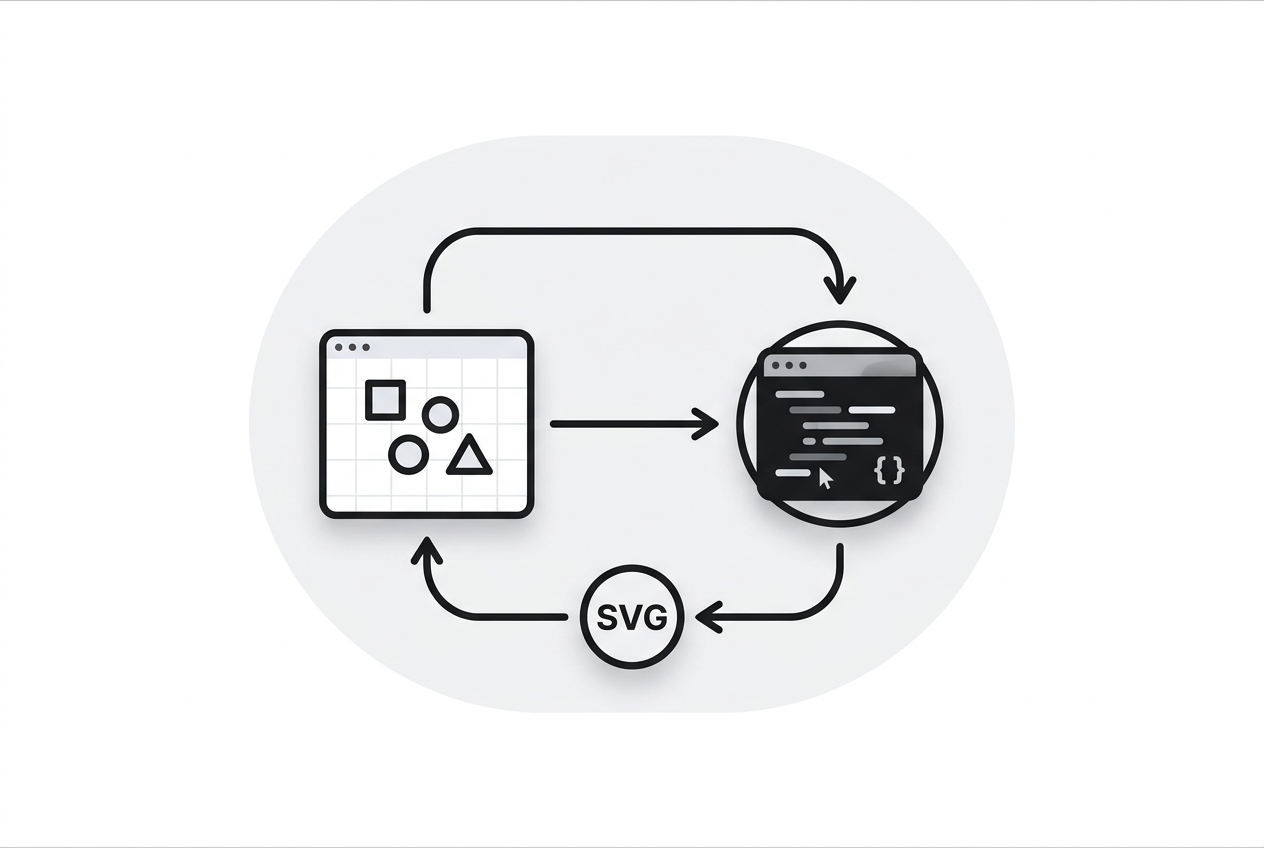
SVG is the hinge that makes the whole loop possible. It means a drawing can be a prompt and a prompt can be a drawing. You get "two very different tools for drawing much more than you could before," and neither one owns the artifact.
But the sharpest line in the thread is the one about dials. "When you're using an LLM to generate the SVG, you can ask for the relevant dials so that you can get it tweaked exactly right before exporting it."
That single sentence is taste operationalized. The LLM can render an SVG. It cannot know whether the curve is elegant, whether the weight is right, whether it reads at small sizes. So Kennedy doesn't ask for the finished thing — he asks for the parameters, then turns them himself until it's right.
This is the relocated skill boundary in one move. Execution: outsourced. Specification of what's adjustable: his. Final judgment against a standard the tool has no access to: entirely his.
The video flow is where the capability jump gets impossible to argue with. He needed a clip of a quantum wavefunction — which he describes as "fiendishly complex." His insight: many videos can be specified in code, and anything on an HTML canvas exports easily to video.
Seven prompts. Done.
Then the detail that should stop you: "I tried this in November with ChatGPT and it was impossible to create." Not slow, not clunky — impossible. Later, per his thread, the video was seven prompts total.
Sit with that gap. A creative task reportedly moves from impossible to smooth in a matter of months — though Kennedy also says he used LLMs to learn the required math and science along the way. If the difficulty of execution can swing that violently, that fast, then execution is a terrible place to build your competitive identity.
You cannot compete on a variable the labs reset every quarter. What was your hard-won moat in November is a seven-prompt commodity by spring. Anyone who staked their value on "I can produce this" just watched the floor drop.
What doesn't swing is the rest of it. Knowing you needed that specific wavefunction and not a generic swoosh. Knowing which dials to ask for. Knowing, when it came back, whether it was right — a judgment the canvas can render but never make.
The animation flow says the same thing from another angle. Kennedy notes that, per his thread, "animations in Figma are slow & limited," and that LLMs "make 'em fast and easy," so he has Claude prototype clickability affordances. The machine handles the tedium of iteration; he stays in charge of what the affordance should feel like.
And the widget flow closes the loop on why this isn't drudgery. "Design what you want to look at in Figma, add interactivity and state in code" — a workflow that, three years ago, "you literally couldn't do this 3 years ago without significant developer help/expertise." That's not a faster horse. That's a designer doing something that used to require hiring someone.
His "hot take: we're sleeping on widgets" is really a claim about newly available creative range. Interactive artifacts just became solo-authorable. The bottleneck that made them a team sport is gone.
So here's the durable point, and it's the opposite of the anxiety we keep being sold.
When the same capability can be impossible one month and smooth the next, execution stops being where you compete. It becomes weather — conditions that shift under you regardless of effort. Betting your career on it is betting on the forecast staying wrong.
What's left is where Kennedy actually spent his judgment. Taste: knowing what good looks like when the tool hands you ten plausible outputs and can't rank them. Format-fluency: knowing SVG bridges Figma and code, knowing an HTML canvas becomes a video, knowing which tool evaluates which decision best. And discipline: the rule that every visual starts in Figma, that origination stays human even when elaboration is free.
None of those three got cheaper. If anything they got more valuable, because they're now the only scarce inputs left in the pipeline.
The tool speaks SVG, speaks code, speaks video. It does not speak taste. It can generate the wavefunction in seven prompts and has no idea whether the wavefunction is beautiful, legible, or worth including at all. That evaluative gap is permanent in a way the capability gap is not.
Which returns us to that buried admission. Kennedy couldn't write this article for years — not because his standards were too high, but because a specific capability was missing. The LLM supplied the capability. His taste supplied everything that made the capability worth having.
That's the practitioner model, and it's a rebuttal to both fears at once. AI didn't automate his taste away. It didn't relegate him to drudgery. It handed him execution for free and left every consequential decision — what to build, which dials to turn, what to keep — exactly where it always was.
He calls himself "just one blind mouse feeling out a wild new frontier." Maybe. But he's the one holding the map, because he's the only one in the room who knows what he's looking for.