Citadel Securities Buys Into Crypto.com at $20B as Wall Street Doubles Down on Exchange Rails
Citadel Securities wrote a $400 million check for Crypto.com at a $20 billion valuation, and it did so while, per Decrypt's deal coverage, Bitcoin was reportedly down 28% on the year, and per a separate macro snapshot near $63,200, with the broader crypto market having shrunk to roughly $2.2 trillion.
Read the calendar against the tape and the deal looks backwards. The money arrives as the thing it's ostensibly buying — spot exchange volume — is under pressure, with Bitcoin down 28% on the year and crypto majors down 2-3% on the day the news broke.
That same week, Morgan Stanley switched on spot Bitcoin, Ethereum, and Solana trading for E*Trade's self-directed channel, which per Morgan Stanley's latest financial supplement served 8.6 million households holding about $1.56 trillion in assets as of March 31. And Marex began letting clients post USDC as initial margin for U.S.-regulated futures and options, powered by Coinbase's infrastructure.
So here is the question the press releases carefully do not answer: if the trading business is shrinking, what exactly is Wall Street paying up to own?
Start with the tell that no one has flagged loudly enough. Citadel now holds $600 million across two direct rivals — $400 million in Crypto.com and $200 million in Kraken, put in last November alongside Jane Street — and both stakes were struck at the identical $20 billion valuation.
You do not back both horses in a two-horse race if you're betting on a horse. You back both if you're betting on the track.
You do not back both horses in a two-horse race if you're betting on a horse. You back both if you're betting on the track.
The framing from Crypto.com and Citadel confirms where the eyes are pointed, and it isn't the order book. Marszalek: "The size of the opportunity in front of us is staggering, as crypto increasingly becomes the rails for finance." Citadel president Jim Esposito calls it "the convergence of traditional financial markets and digital asset infrastructure."
Neither man mentions spot trading fees. Both mention tokenized securities, derivatives, and 24/7 markets — the pipes and what will one day flow through them, not the volume running through them today.
That reframes the entire week. Morgan Stanley didn't route E*Trade's crypto trades through its own book; it pushed them through Zero Hash accounts held separately from the bank and explicitly not covered by FDIC or SIPC.
The bank isn't market-making the trade. It's owning the funnel — 8.6 million households, one integrated screen where crypto sits beside stocks, IPOs, and retirement accounts — and renting the execution and custody plumbing from a specialist.
Marex's move rhymes. Turning USDC into futures collateral doesn't chase spot volume either; it makes the best collateral one that "can move 24/7, whenever the market does." That's an infrastructure bet on capital efficiency, not a directional bet on price.
Line the deals up and a single logic emerges. Citadel, Morgan Stanley, and Marex are each buying a call option on the distribution rail itself — the venue, the retail funnel, the settlement-adjacent plumbing — precisely because the option's value is decoupled from this quarter's trading revenue.
That's why a 28% Bitcoin drawdown leaves the deals unbothered. You don't reprice an option on where finance settles in five years because spot turnover dipped this quarter.
The pattern extends beyond Citadel. Intercontinental Exchange, which owns the NYSE, has taken a stake in OKX; Nasdaq put $50 million into Gemini. The same institutions that spent a decade dismissing crypto are now positioning to own the rails, and they are pointed at the same destination: tokenized assets moving around the clock.
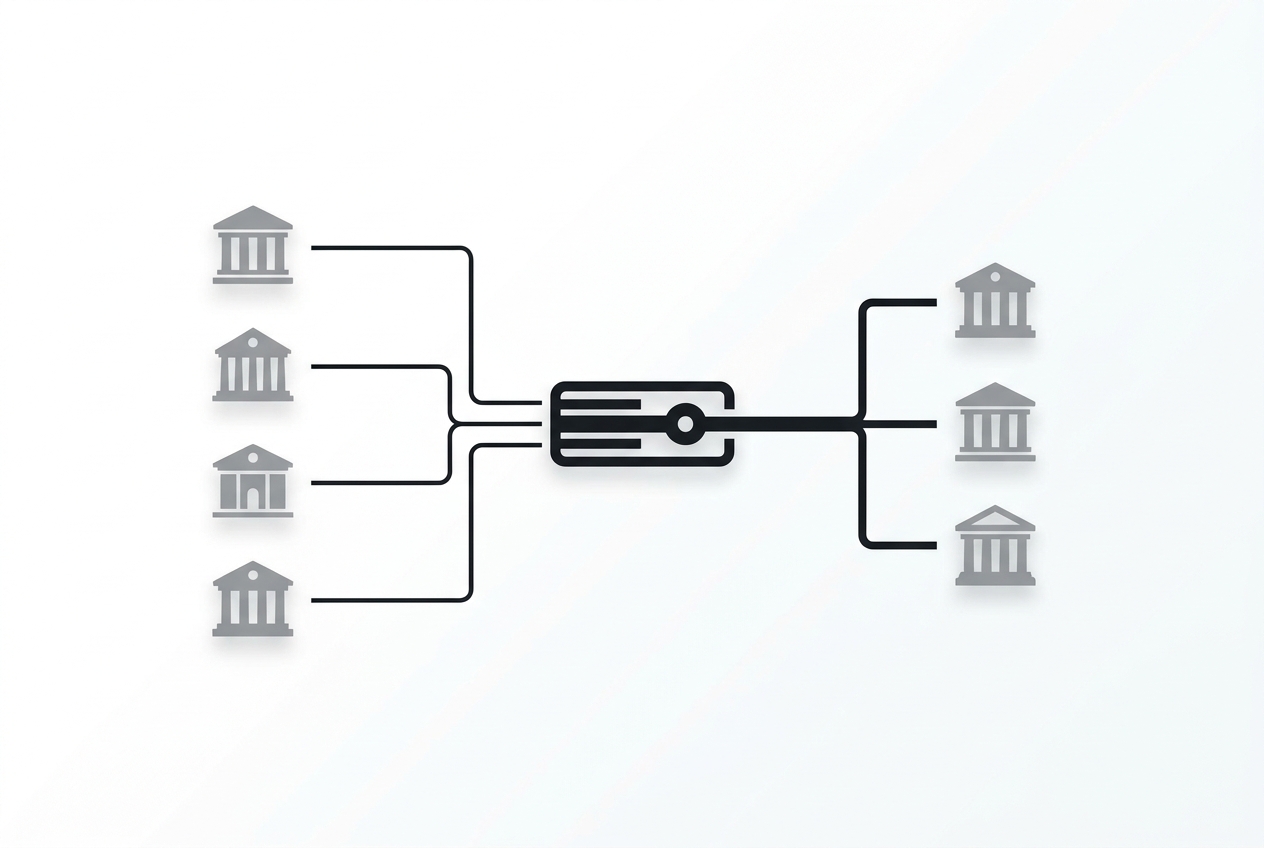
Crypto.com is a rational target for that thesis regardless of its trading rank — it sits 11th by volume on CoinMarketCap. It won conditional approval for a U.S. national trust bank charter in February, and per Decrypt's newsletter coverage it says the fresh capital will fund expansion into tokenized securities, derivatives, prediction markets, and real-world assets.
The regulatory perimeter and the multi-asset roadmap are the product. The spot order book is just the entry point.
But here is where the strategic conviction thins out, and where the acquirers go conspicuously quiet.
Only Kraken disclosed what Citadel actually does inside the venue. Its collaboration includes differentiated liquidity provision, risk-management expertise, and market-structure insights — a defined operational role you can point to.
Crypto.com disclosed none of that. Its filing names no board seat, no ownership stake, no voting rights, no exclusive commercial terms, and — critically — no liquidity or market-structure mandate matching Kraken's.
Crypto.com hasn't even confirmed whether Citadel received board representation. On the operational relationship, the document is blank.
That blank matters more than the headline number. Back in February 2025, it was reported that Citadel was preparing, subject to exchange approvals, to provide liquidity on Crypto.com and other venues — plans involving the platform, not a confirmed bilateral relationship.
So the honest reading, absent further disclosure, is the simpler one: Citadel has taken economic exposure to two competitors chasing the same bridge between crypto and traditional markets, and left itself free to profit from the shift without depending on either winning.
That is a hedge. A sophisticated, well-capitalized hedge — but a hedge, dressed in the language of "convergence" and "the capital markets of the future."
The distinction is not academic. A liquidity or market-structure mandate would make Citadel a builder of the rail. A passive $400 million stake with undisclosed terms makes it a landlord collecting optionality on both sides of a race it refuses to call.
The word doing the heavy lifting in every quote — "convergence" — can describe either. Which one it actually is depends entirely on the operational terms that Crypto.com, for now, has chosen not to publish.
That's the tension the checks can't resolve on their own. The capital is real, the $20 billion valuation is real, the retail funnels and the USDC collateral are live and shipping.
What remains unstated is whether any of it obligates the acquirers to anything beyond holding the position. Wall Street is unmistakably buying the pipes. Whether it has committed to running them — or merely to owning a claim on whoever does — is the part the announcements leave blank, and it is the only part that tells you if "conviction" is the right word.
Watch Crypto.com's next disclosures. A defined liquidity, risk, or market-structure role would move this from capital allocation to genuine partnership, the way Kraken's did. Its continued absence would confirm what the identical valuations already suggest: that the smartest money in the room is positioning for the rail, not the race — and is careful not to say so out loud.