
Here is a small contradiction that tells a large story. The press releases announcing this discovery say 3I/ATLAS ranks "among the most methanol-rich solar system comets ever studied." But 3I/ATLAS is not a solar system comet. It was born around another star.
That slip — treating an interstellar interloper as if it belonged to our own family — is exactly the assumption the object is quietly demolishing.
The number underneath the headlines is stark. Using the Atacama Compact Array of ALMA, Nathan Roth and colleagues reportedly measured the ratio of methanol to hydrogen cyanide streaming off 3I/ATLAS on two dates: roughly 124 on September 12 and 79 on September 15 (with substantial uncertainties).
Those are, in the authors' own words, "among the most enriched values measured in any comet." Of every comet humanity has ever fingerprinted at radio wavelengths, exactly one out-alcohols this visitor from the void — the anomalous solar system comet C/2016 R2 (PanSTARRS).
Methanol is reportedly used for industrial purposes on Earth, in contrast to the drinkable ethanol in a glass of wine. It is not rare in space; it condenses onto icy dust grains in cold molecular clouds and gets baked into comets as planets form. What is rare is this much of it, relative to the nitrogen-bearing hydrogen cyanide that most comets carry in more balanced proportion.
"Observing 3I/ATLAS is like taking a fingerprint from another solar system," Roth said of the work. "The details reveal what it's made of, and it's bursting with methanol in a way we just don't usually see in comets in our own solar system."
It's bursting with methanol in a way we just don't usually see in comets in our own solar system — like taking a fingerprint from another solar system.
So why does the ratio matter? Because comet chemists reportedly have three standard stories to explain an alcohol overload, and 3I/ATLAS refuses to sit still for any one of them.
Story one: it formed cold. Ices assemble in different proportions depending on where in a disk they condense, marked by "snowlines" where particular molecules freeze out. Form your comet near a different snowline — say, closer to where methanol freezes — and you inherit a different recipe.
Story two: it was irradiated. A nucleus baked for eons by starlight, or scoured by galactic cosmic rays drifting through interstellar space, has its surface chemistry rewritten. The same team that found the methanol notes that 3I/ATLAS's earlier oddities were read this way too.
Story three, the unsettling one: it reportedly simply started with an alien inventory. The disk that made it was stocked differently from ours at the outset, and no amount of processing is required to explain the imbalance.
Here is the problem. Each story can be made to fit the methanol alone. None of them comfortably absorbs everything else this comet has done.
Because the alcohol is not the first surprise. When the James Webb Space Telescope caught 3I/ATLAS far from the Sun, at 3.32 astronomical units, its coma was reportedly dominated by carbon dioxide — a CO2-to-water ratio of 7.6 (±0.3), wildly high by solar system standards.
That CO2 excess was already being explained by the same menu: harsh radiation, or formation near the CO2 snowline, or cosmic-ray-processed ice. Then optical observers reportedly found the comet strangely enriched in nickel relative to iron. Now add the methanol.
Stack the anomalies and each tidy explanation starts to strain. A cold formation zone that explains the CO2 does not obviously deliver the nickel. A radiation history tuned to the alcohol is not the same knob that sets the metal ratios. The object keeps handing us clues that point in slightly different directions.
This is the deeper reason the methanol result matters more than another "weird comet" headline. It exposes how much of our comet-formation textbook rests on a sample of one — our own solar system — and quietly assumes that sample is representative.
And then the observations offer something rarer than a chemical census: a glimpse of the machinery.
ALMA's resolution let the team watch not just what molecules were present, but where they came from. Hydrogen cyanide behaved like a well-mannered solar system comet, streaming directly off the nucleus, its emission indistinguishable from simple sublimation at the core.
Methanol did not. The analysis reportedly found methanol being released from sources spread across the coma — with a parent scale length beyond 258 kilometers from the nucleus, at 99 percent confidence — not only from the nucleus itself, though low signal-to-noise on the smallest scales meant the authors could not definitively rule out methanol as purely a nucleus species.
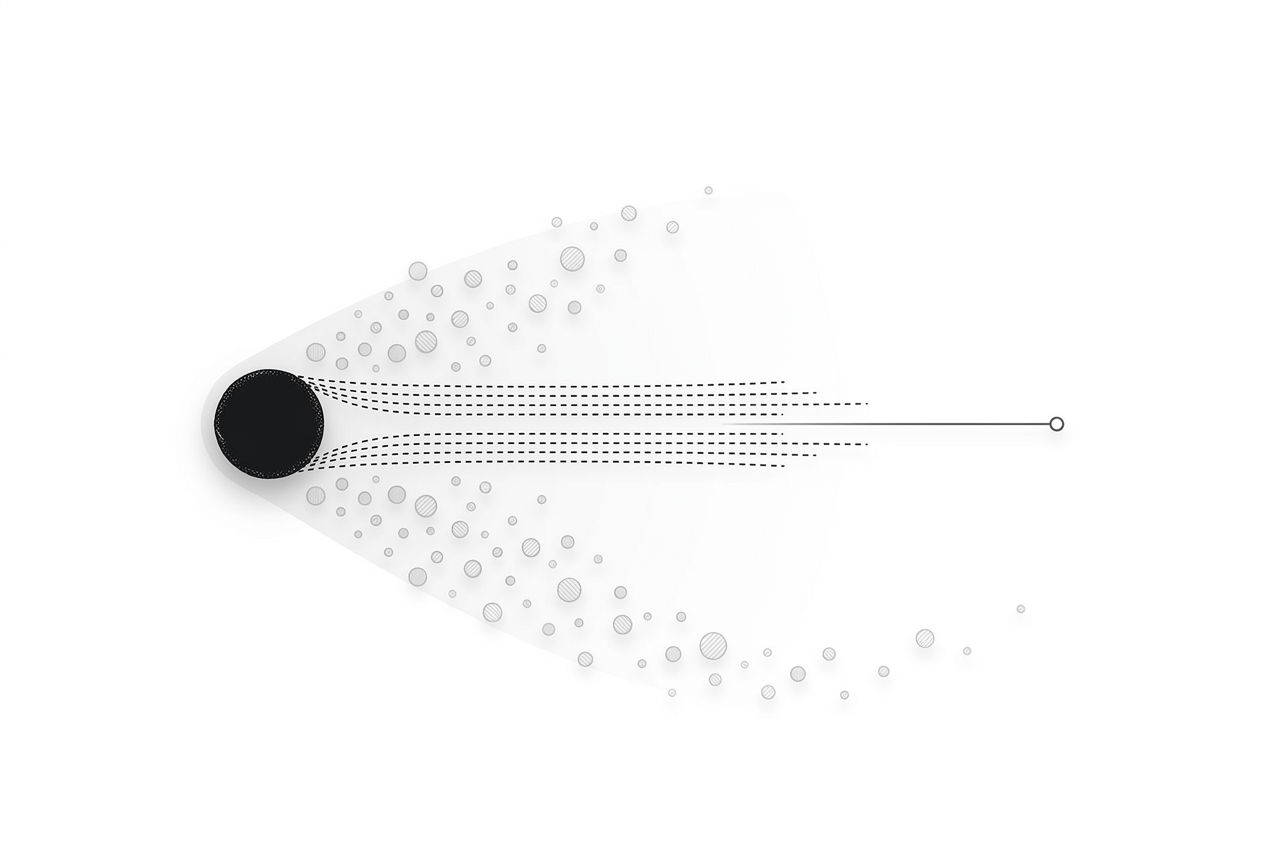
The interpretation is vivid: tiny icy grains, flung off the comet, are acting as miniature comets in their own right. As they drift outward and warm, they sublimate their own methanol into the surrounding cloud.
Astronomers have seen this "distributed source" behavior in a few solar system comets before. But this is the first time the detailed physics of that outgassing has been traced in an object from another star.
That distinction is the whole game. A bulk abundance tells you what another disk contained. Watching methanol peel off individual grains at a measurable distance tells you something about how that disk packaged its ice — how the alcohol was bound, in grains versus nucleus, in a body assembled under a foreign sun.
There is even a temporal clue. The methanol production rate reportedly climbed sharply from August through October, with an uptick right at the inner edge of the water sublimation zone near 2 astronomical units — the comet's ices switching on in sequence as it fell toward the Sun.
Now step back to the full census of alien planetary chemistry we have ever directly sampled. It is not large. It is two.
'Oumuamua, the first interstellar object, reportedly showed no discernible coma — a fingerprint we never got to read. The first interstellar comet, 2I/Borisov, did give us one: an unusual carbon-monoxide-to-HCN ratio, even though its CN-to-water reportedly looked reassuringly familiar.
And now 3I/ATLAS, drenched in methanol, overloaded with CO2, enriched in nickel. Two interstellar comets have offered up their volatile chemistry. Both broke the rules we built from home.
The temptation, when a strange object arrives, is to reach for a strange explanation — and speculation has swirled online about whether 3I/ATLAS might be artificial. The evidence points the other, more interesting way. A comet-like tail, gas jets, grains sublimating methanol, hydrogen cyanide venting from a nucleus: this is a natural icy body, behaving like one, made of the ordinary molecules of star and planet formation. Its foreignness is chemical, not manufactured.
Which leaves the humbling possibility. When your sample of alien planetary systems is two, and two out of two defy your model, the honest read is not that our neighbors are exotic. It is that our own recipe might be the parochial one — and that diversity, not our textbook, is the rule.
We will not fly a probe to another protoplanetary disk in any of our lifetimes, or our grandchildren's. The distances forbid it. But every few years, the galaxy throws one of its own building blocks through our neighborhood, free of charge, for anyone with a telescope pointed the right way.
3I/ATLAS is the closest look we are going to get at how another star built its ices. The methanol is not the punchline. It is the reminder that we have been writing universal laws from a single example — and the universe has started sending us the counterexamples in person.