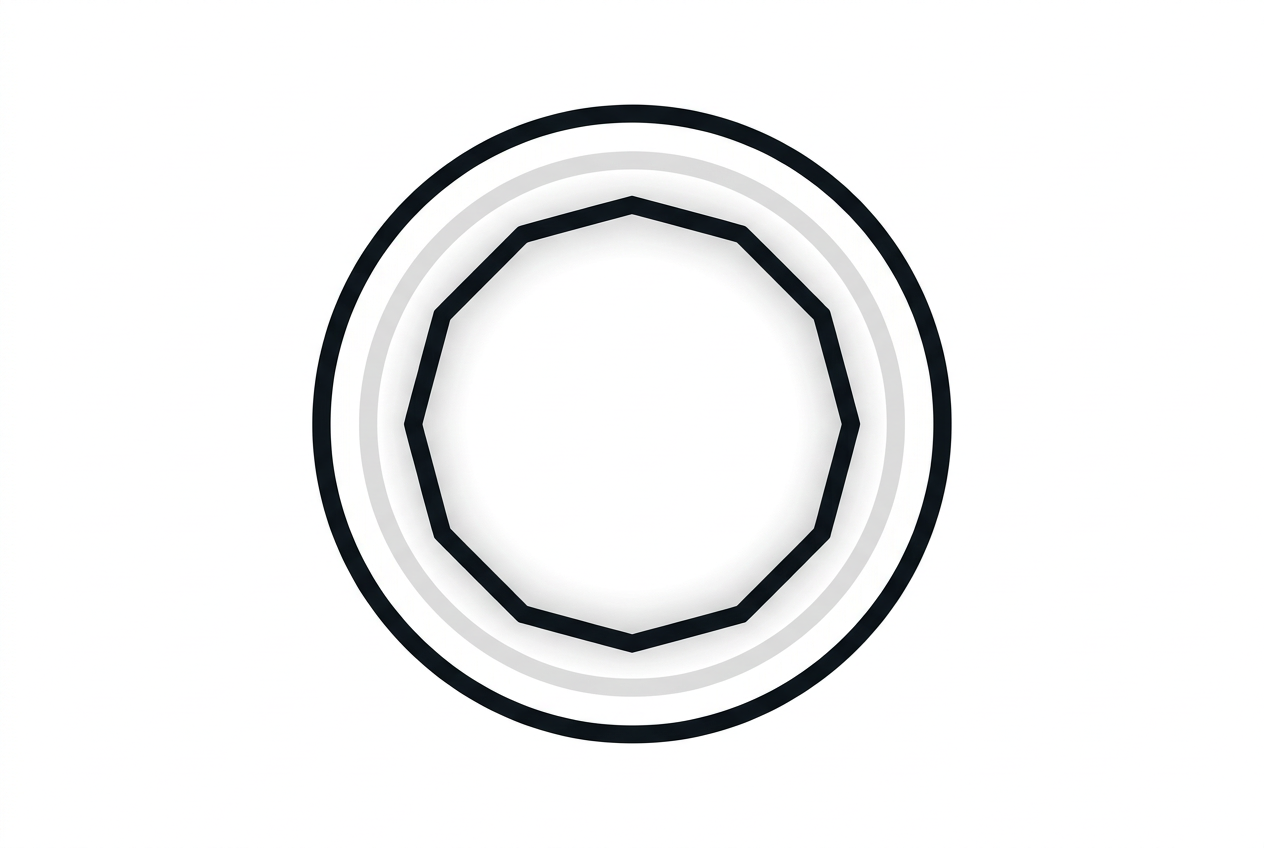
Article — "Hubble finds a decagon at Saturn's south pole, mirroring but defying the northern hexagon": Article — "Hubble finds a decagon at Saturn's south pole, mirroring but defying the northern hexagon": Here is a contradiction worth sitting with. For more than four decades, scientists knew Saturn's north pole wore a hexagon, and for exactly that long they assumed the south must hide a twin. The planet's jet system is famously symmetric north to south, so the logic seemed airtight: find the pole, find the six-sided wave.
They found the pole. What they found on it has ten sides.
Start with why a corner should not exist at all. A gas giant this size, spinning once every 10.7 hours, is a machine for erasing corners. Gas wants to drift from the warm equator to the cold poles, but the spin whips it sideways before it gets far, ironing everything into smooth circular bands. A jet with ten crisp vertices is an affront to that tidiness — and Saturn now has one at each pole, with different numbers of sides.
That mismatch is the whole story. Not the strangeness of a polygon, which Saturn already taught us to expect. The strangeness of the wrong polygon, in a place that was supposed to hold a copy.
The strangeness of the wrong polygon, in a place that was supposed to hold a copy.
Agustín Sánchez-Lavega of the University of the Basque Country, who led the study published September 2 in Science Advances, has been hunting the southern twin in Hubble images since 1990. Cassini, which orbited Saturn from 2004 to 2017 and studied it in obsessive detail, "showed no inkling of a long-lived formation, either," he said. The south simply refused to cooperate.
The reason the search stalled is geometric bad luck. Saturn's axial tilt turned its south pole away from Earth in mid-2012, and it did not swing back into view until 2023. For eleven years, nobody could look.
So the decagon was born in a blind spot. The AP report notes the team suspects it formed sometime between 2017 and 2023 — after Cassini went silent, before Earth's line of sight returned. We are, in effect, examining a crime scene with no witnesses to the crime.
That timing is what makes this more than a curiosity. Agustin Sanchez-Lavega and amateur observers Trevor Barry and Jean-Paul Oger noticed a faint undulating band in ground-based images in 2024; Hubble then confirmed the feature back to 2023, when its vertices were weaker and its sides less defined. It is still sharpening.
"The northern hexagon has been there every time we've looked for more than 40 years," said Amy Simon of NASA's Goddard Space Flight Center. "This feature is different — it appears to be strengthening, giving us the rare opportunity to watch a giant atmospheric pattern develop."
Read that carefully. The hexagon is, in a sense, a fossil we reportedly inherited already present in the Voyager images of 1980 and 1981. The decagon is a process, caught mid-assembly. We are reportedly, per the study team, getting a rare opportunity to watch one of these polygons decide what it wants to be.
To see why that matters, you have to understand what the polygon actually is — and what it isn't. It is not a shape drawn on the clouds. It is a standing wave riding a jet stream, and the numbers prove it.
The decagon drifts eastward at just 2.5 meters per second. The zonal jet beneath it, at 60.5°S, screams along at 116 meters per second. The pattern and the flow are almost completely decoupled: the wind roars through the wave the way water pours through the standing ripple downstream of a rock in a river.
The wave also breathes. Its ten vertices don't sit still in longitude — they oscillate on a 32-day cycle, swinging back and forth by 4.6 to 8.4 degrees. This is a living oscillation, not a frozen etching.
And it has depth. The pattern shows up across wavelengths that probe different altitudes — from the deep clouds at red continuum wavelengths up through the methane absorption band that samples high-altitude haze — spanning pressures from roughly 10 millibars to 2 bars. It runs vertically through the atmosphere like a pillar, exactly as the hexagon does.
Put those three facts together and the interpretation follows. The authors describe the decagon as a large-scale meandering wave, trapped vertically and pinned in latitude by the curvature of the dominant jet. It is jet architecture, not cloud decoration.
Now we can ask the real question, the one polar-vortex theory cannot yet answer. What sets the number of sides?
In the physics of these trapped waves, the wave number — six here, ten there — may be fixed by a small set of parameters: the speed of the jet, how sharply it curves, and the latitude at which it sits, though the evidence does not establish this. Change those, and the polygon the flow can support might change with it.
Saturn's north jet peaks near 100 meters per second and centers around 78.5°N; the southern jet carrying the decagon runs at 116 meters per second and centers near 60.5°S. Different speed, different latitude, different curvature — and, apparently, a different preferred wave number, though the evidence does not confirm this causal link.
That, arguably, is the payload of the whole discovery. The 6-versus-10 mismatch may not be a coincidence to be explained away. It could be a measurement of how strongly the shape depends on the underlying flow, written across the same planet twice, under conditions we can actually compare — though the evidence leaves the cause unexplained and requiring further study.
The authors' shallow-water simulations point to two candidate triggers. The decagon may have grown from a spatially periodic disturbance riding the peak of the jet, or it may have been kicked into existence by a dark anticyclonic vortex sitting just to its north — a Red Spot about 4,000 kilometers across, tracked from 2023 to 2025, drifting at 23 meters per second.
Either way, the tentative lesson may be the same: give a fast jet the right nudge, and it may select a polygon. The number of sides could be the jet's answer to the question, not the storm's — though the evidence stops short of this conclusion.
This is where a live experiment beats a fossil. With the hexagon, we have one data point held for more than 40 years and no memory of its birth. With the decagon, we get to watch the selection happen — to see whether it locks into a stable ten like its northern cousin, which was already present when first observed, or whether it wobbles, wanders, and dissolves.
Simon is honest about the uncertainty. Gas giants "look nice and serene, but they're very windy," she said; features like these "can last for decades, but on the other hand things can change very fast." She hopes it survives a few more years. Hubble was already scheduled to check back this month, with the James Webb Space Telescope and fresh model runs to follow.
The stakes reach past Saturn. Jet-trapped polar waves are a general phenomenon of rotating fluid atmospheres, and the models being tested here may be the same ones we lean on to interpret Jupiter, the ice giants, and eventually the atmospheres of exoplanets we will never resolve this sharply, though the evidence does not confirm this.
If a model can predict why the same planet chooses six sides in the north and ten in the south — from jet speed, curvature, and latitude alone — that could arguably be a validation test almost nothing else in the solar system can offer, though the evidence does not support this claim. Two poles, one planet, two different answers, and now a clock running on the second one.
For forty years the question was where Saturn's southern hexagon was hiding. The better question turned out to be why the planet, given a second chance, didn't build a hexagon at all.