Article — "IXPE may have caught quantum vacuum birefringence around a magnetar, a 90-year-old prediction": Article — "IXPE may have caught quantum vacuum birefringence around a magnetar, a 90-year-old prediction": Sixty-five percent at 2 keV, rising to nearly 80 percent at certain rotational phases, then dropping sharply between 2 and 4 keV.
That is the polarization signal Rachael Stewart and her colleagues extracted from the magnetar 1E 1547.0−5408, and it is the number that carries the whole claim. Their conclusion in Nature is unambiguous: this behavior "cannot be consistently explained without invoking magnetospheric vacuum birefringence."
Here is the twist that should make you slow down before you accept the headline. A second team, led by Roberto Taverna, analyzed the identical 500-kilosecond IXPE observation from March 2025 and came back with a different verdict.
Same star. Same photons. Same instrument. Taverna's group reports a phase-averaged polarization degree of 47.7 percent ± 2.9 percent and states, flatly, that the high polarization "cannot be regarded as compelling evidence for the presence of vacuum birefringence."
That disagreement — not the effect itself — is the real story here. It is a clean, public illustration of how strong-field physics gets tested when you cannot build the laboratory.
Same star. Same photons. Same instrument. Two teams, two verdicts — that disagreement, not the effect itself, is the real story here.
Start with what the effect is, because it is genuinely strange. In 1936, Werner Heisenberg and his student Hans Euler worked out that the quantum vacuum is not empty. It seethes with virtual electron-positron pairs flickering in and out of existence.
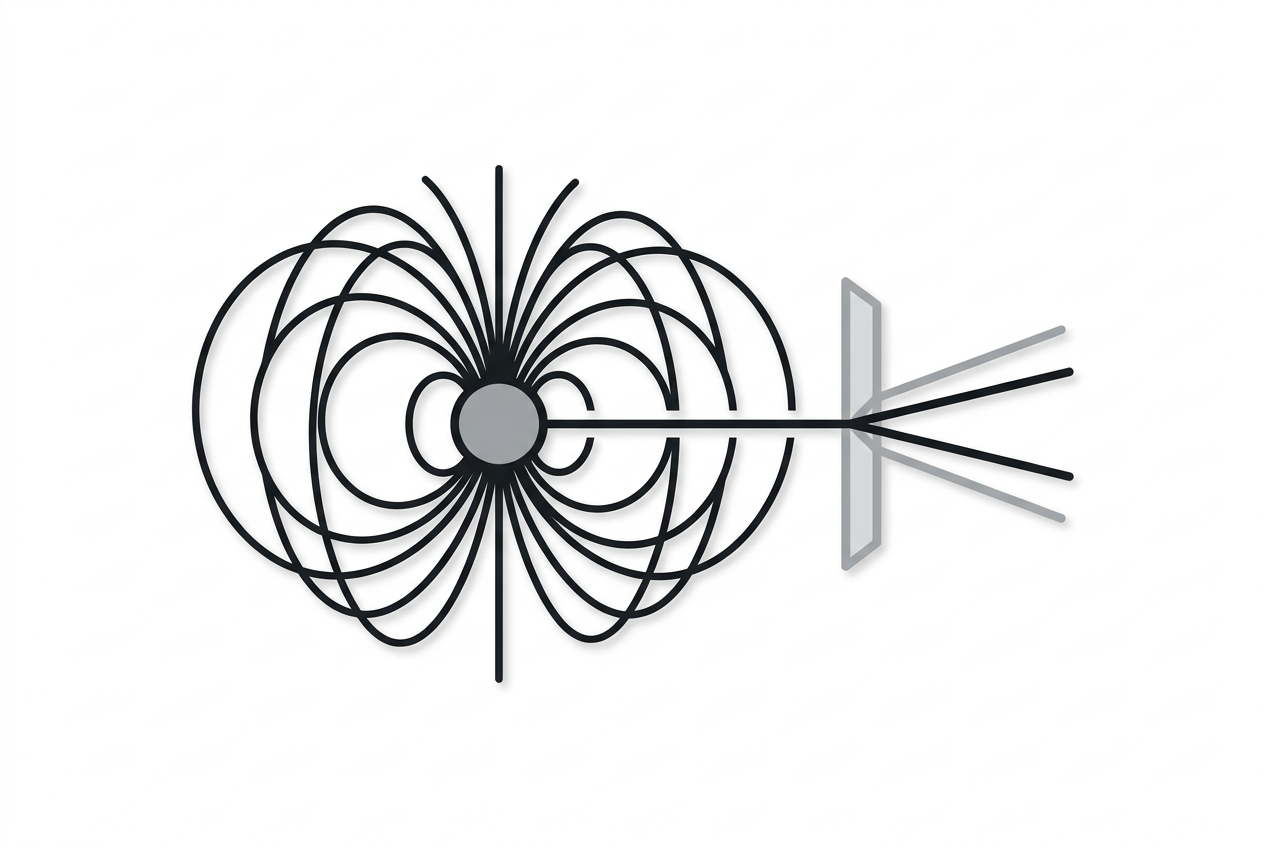
In an ordinary field, those pairs stay invisible. But soak the vacuum in a strong enough magnetic field and they respond — they polarize — and the "empty" space starts to behave like a crystal. Light of one polarization travels slightly faster than light of another.
That is vacuum birefringence: nothing at all, acting like a prism.
The catch is the field strength you need. The critical magnetic field where these effects switch on is about 4.4 × 10^13 gauss. The strongest steady fields humans have ever built in a lab fall short of that by orders of magnitude.
This is why people chasing the effect on Earth have kept coming up empty. The PVLAS experiment tried to catch it with a permanent magnet and a laser and found nothing. As Marcus Lower, a co-author on the Stewart paper, put it, people have tried "using really powerful lasers or big particle accelerators and colliding particles at almost the speed of light to try and measure these tiny little fluctuations."
His verdict on the terrestrial route is blunt: "The kinds of magnetic fields that you need just don't exist on Earth."
They exist on magnetars. These are neutron stars — the collapsed cores of dead massive stars, a Sun's worth of mass packed into a city-sized ball — with surface magnetic fields of 10^14 to 10^15 gauss, the strongest in the observable universe. Per one analysis, roughly ten to a hundred times the critical field.
1E 1547.0−5408 is a particularly useful one. It spins once every two seconds and, unusually, blazes in both radio and X-rays, which let the team coordinate NASA's IXPE, its NICER instrument, and CSIRO's Parkes/Murriyang radio dish on a single target.
The tool that reads all this is X-ray polarimetry. IXPE, launched in 2021, measures not just how many X-ray photons arrive but how their electric fields are oriented — the Stokes parameters that encode polarization degree and angle.
Crucially, it can slice that measurement two ways: by photon energy, and by rotational phase as the star spins. That is what turns a single number into a diagnostic.
Now the logic of the Stewart claim. The measured polarization reportedly runs nearly three times higher than in comparable sources, and the geometry of the star's field suggests the measurements should be close to zero at certain points in the star. Standard surface-emission models cannot produce a value that large.
So something must be boosting it. Birefringence does exactly that: as photons stream outward through the magnetosphere, the birefringent vacuum reportedly keeps their polarization modes aligned over a huge volume, so the light arrives far more organized than the surface alone would allow. Stewart's team ran atmospheric radiative-transfer models constrained by the radio data and found they could not reproduce the observations without it.
Here is where the two teams diverge, and it is worth being precise about how.
They do not disagree about the raw data. Both see high polarization. Both see a dip in polarization degree in the 3–4 keV range — Taverna's group calls it evidence at the 1σ level of a minimum, "compatible with what is expected by partial mode conversion at the vacuum resonance in a magnetized atmosphere."
They even agree that QED effects are lurking. Taverna's paper says the results "hint once more at the presence of QED effects in magnetars."
The disagreement is about whether this specific observation proves it. Taverna's team fit the phase-dependent polarization angle with a rotating vector model — the classic geometric description of a spinning dipole — and, per their paper, this constrains the source geometry and reproduces the modulation of the polarization angle, alongside phase-resolved analysis indicating a single small hot spot with a non-uniform temperature.
Per Taverna's framing, under this misaligned geometry the high polarization is not compelling evidence — a smoking gun. It is suggestive, not compelling. Their title says it outright: "the elusive smoking gun."
The number gap between the two papers reflects the choices underneath. Stewart quotes 65 percent at 2 keV; Taverna quotes 47.7 percent averaged across the 2–6 keV band. Different bands, different phase treatments, different models feeding the interpretation.
That is the crux. Neither team measured birefringence directly. Both measured polarized X-rays and then ran the numbers through models — atmosphere models, radiative-transfer codes, geometric fits — to decide what the vacuum was doing far away.
The inference lives inside the models. Change your assumptions about the surface, the atmosphere, or the viewing geometry, and the conclusion can flip from "requires birefringence" to "explainable without it."
This is not a scandal. It is what physics looks like when the laboratory is a star you can only watch.
You cannot rerun the experiment with a knob turned. You cannot isolate the variable. You get one 500-kilosecond glimpse of one rotating object, and every route from photons to conclusion passes through theory you also have to trust.
To the credit of the people involved, they know it. Hoa Dinh Thi, co-lead of the Nature paper, framed the finding carefully: the model "requires the presence of vacuum birefringence" to satisfy both X-ray and radio constraints — a statement about what the model needs, not a bare observation. Lower admitted the team "initially felt very cautious about making such a bold claim."
That caution is the honest posture. Even NASA's own writeup hedges in the headline verb — IXPE "may have" proven a 90-year-old theory — and notes the result "could be" the first direct observation anywhere.
So what would turn "may" into "did"? Replication, in two directions.
More magnetars, first. IXPE has already studied several, and the polarization patterns differ from source to source — 4U 0142+61 shows a dramatic 90-degree polarization swing near 4 keV, others do not. A birefringence signature should show up consistently, shaped by field strength and geometry in predictable ways, across the population rather than in one convenient star.
Better instruments, second. The planned eXTP mission is being designed with the sensitivity to measure the effect quantitatively, and one analysis argues that both IXPE and eXTP should be capable of it — with a different magnetar, 1RXS J170849.0−400910, as possibly the best target of all.
That is the real payoff of the two-paper standoff. It hands the field a sharp, falsifiable question and a clear method for answering it, instead of a press release to file under "settled."
The strongest magnetic fields in the universe are testing quantum electrodynamics in a regime no collider on Earth can reach. That much is not in dispute.
Whether we have watched empty space bend starlight — that still rides on which model you believe. Which is exactly why the honest verb, for now, is still "may."