
There is a rover in the rendering, trundling across grey regolith with a payload strapped to its back, Earth hanging blue in the black behind it. It is a clean, confident image of lunar delivery: your cargo, safely on the Moon, moving toward its destination.
Then you remember that the company selling this service has arrived at the lunar surface exactly twice, and both times as a crater.
That is the tension worth sitting with. Ispace's HAKUTO-R Mission 1 ran out of propellant just short of the surface in 2023 (launched 2022), felled by a software error. Mission 2 reportedly came down in 2025, killed by a hardware failure. Two attempts, two impacts, zero soft landings.
And yet this month, at the Spacetide conference in Tokyo, ispace announced it is becoming a "Lunar Access Integrator" — the company that will shepherd your payload from mission design all the way to operating on the Moon's surface. It has bought 500 kilograms of capacity on a SpaceX Starship lunar lander, reportedly for $50 million per Tokyo Brief, to fly no earlier than 2030.
Here is the part that makes the move interesting rather than absurd: ispace is not selling its own landing. It is selling everything around the landing.
Under the new service, ispace helps global customers design their missions, integrates their payloads on the ground, buys the ride on Starship, installs the system for launch, and then deploys and operates it on the surface. The deploy-and-operate part runs on a new Mobile Cargo System — a rover, separate from ispace's own ULTRA lander, that reportedly carries cargo up to a few kilometers from wherever Starship touches down.
Look at that list carefully. SpaceX does the descent. SpaceX does the touchdown. Ispace does the coordination.
The company has, in effect, stopped betting itself on its own descent engines. The hard, unforgiving, twice-failed part of the job — putting mass gently on the Moon — is outsourced to the one entity that plans to fly Starship to the lunar surface anyway, reportedly first for NASA's Artemis program in 2028.
The hard, unforgiving, twice-failed part of the job — putting mass gently on the Moon — is outsourced to the one entity planning to fly Starship there anyway.
This is genuinely clever. Lander-building is capital-intensive and, as ispace has learned expensively, binary: you either land or you don't. Selling mission design, payload integration, the ride, and a last-mile rover is a service layer — a business you can run even when the vehicle underneath you is someone else's.
Executive Vice President Hideari Kamiya framed it in the vocabulary of ground transport. Ispace's dedicated ULTRA landers are the "taxis." The new Starship-based service is the "bus." One is bespoke and high-value; the other is high-capacity and cheap per kilogram.
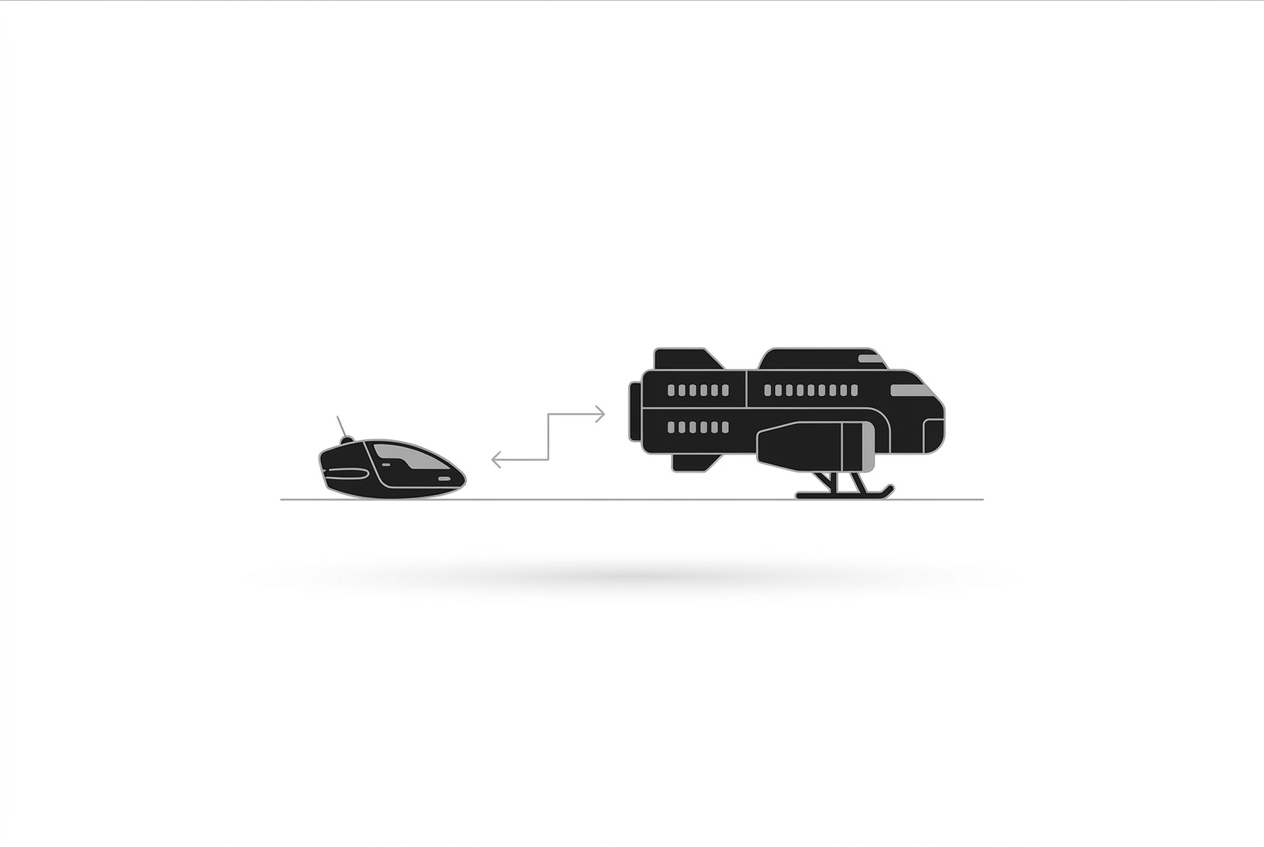
It is a coherent division of labor, and it maps onto a real emerging structure: rockets as launch, Starship as the lunar bus, landers as taxis, rovers as last-mile. The Moon economy, if it exists, will need all of these layers.
But notice who originated the idea. "SpaceX approached us first" with the integrator concept, Hakamada said. This was not ispace inventing a new role from a position of strength. It was SpaceX finding a partner to aggregate small customers onto capacity it will fly regardless.
Which raises the question the whole announcement is built to avoid: what, exactly, is ispace's moat?
Hakamada's answer is telling. "While we can't rule out other companies entering the market, few might be able to integrate cargo and keep providing services after touching down on the moon," he said. The claimed edge is post-landing operations — the very phase ispace has never once reached.
Now stack up what is actually being sold. There is no landing of ispace's own on this mission. There are no disclosed customers yet. And there is no control over the landing site: because ispace is only one of several customers on the Starship flight, SpaceX chooses where it lands — likely the lunar south pole, near NASA's planned base, but not ispace's call.
So the integrator does not control the destination of the cargo it is integrating. It coordinates a delivery to a location chosen by the launch provider, for customers it has not yet named.
Then there is the math. That 500 kilograms is not 500 kilograms of customer cargo. It includes the mass of the Mobile Cargo System rover itself. Hakamada would only say "several hundred kilograms" of actual payload will be available. The headline number is nearly halved once you subtract the vehicle doing the carrying.
And the rover? Ispace says it needs "no technological breakthroughs," leveraging rover technology from its European subsidiary. That phrase is doing enormous work.
This is a company whose two lunar missions failed on a software error and a hardware failure — the mundane, un-breakthrough failures of execution rather than physics. "No technological breakthroughs needed" is precisely the confidence that preceded both craters.
The rover will also ride atop a Starship lunar lander that has itself never landed on the Moon. So the promise is: an unproven rover, carrying several hundred kilograms, deployed from an unproven lander, to a site the operator doesn't pick, for customers it doesn't have, no earlier than 2030.
That is a lot of "no earlier than."
It is worth pausing here to compare this promise to something real, because the contrast defines the whole moment in lunar development. Consider the other end of the same imagined Moon economy: not getting cargo down, but keeping people alive once they're there.
A team from Tohoku University and JAXA recently built a compact plasma device that pulls nitrogen out of habitat air and converts it into dinitrogen pentoxide, using under 100 watts. Dissolved in water, that gas becomes nitrate — the fertilizer plants need — at close to 100% conversion efficiency.
They then grew rice in lunar regolith simulant using the treated water. It didn't just feed the plants. It dropped the soil's pH from a hostile 9.09 to a hospitable 6.76, unlocking trapped calcium, magnesium and potassium, and suppressing aluminum ions that would otherwise poison the roots.
Three months in, the treated rice showed markedly stronger growth than plants given plain water. By the fourth month it reached the heading stage, where grain begins to form. Spraying the gas on the leaves even activated disease-resistance pathways and kept the stems short and sturdy against low-gravity stretching.
That is a demonstrated bench result. Ambition tied to something that actually happened on a lab bench, with numbers you can check.
Set the two side by side and you see the shape of the entire emerging Moon stack. The food-and-fertilizer layer has a small, real, measurable proof. The logistics-integrator layer has a rendering, a purchase order, and a phrase about no breakthroughs.
This is the inversion at the heart of ispace's pivot. The usual order of things is competence first, commerce second: you prove you can do the hard thing, then you sell it. Ispace is selling the coordination of a capability — reliable surface delivery — that it has not yet demonstrated, by attaching itself to a vehicle that also hasn't demonstrated it.
To be clear, the integrator business may well be the smarter bet. Aggregating small payloads onto Starship's enormous, cheap-per-kilogram capacity is exactly the kind of role a mature transport market rewards. If Starship lands, ispace's coordination layer could become genuinely valuable, and far less risky than betting the company on its own descent stage every eighteen months.
The real question is one of sequence. Can these logistics roles — the buses, the taxis, the last-mile rovers, the in-habitat fertilizer plants — be locked in as a durable division of labor before anyone has demonstrated the underlying capability they all depend on?
Or are integrators simply selling a future they are still assuming into existence, booking coordination fees against landings that remain, for now, theoretical?
Ispace still has three ULTRA landing attempts of its own coming, in 2028, 2029, and 2030 — its chance to finally reach the surface intact and earn the operational track record its integrator pitch quietly presumes. That would change everything about how this pivot reads.
Until then, the rendering is the product. A rover that hasn't been built, on a lander that hasn't landed, for customers who haven't signed, arriving somewhere it won't choose. The rice, at least, has already grown.