Here is the contradiction most readers will glide past this week.
Meta's Alexandr Wang reportedly framed the Muse Glimmer release as principle: "personal superintelligence should be available to everyone." Mark Zuckerberg reportedly wrote a long piece around the idea that the future is for everyone.
But the same thread notes, almost in passing, that Muse Glimmer was "evaluated under meta's advanced AI scaling framework and cleared for open-weight release." Those two things sit uneasily together. A gift does not require a safety review with a release gate. A weapon does.
A gift does not require a safety review with a release gate. A weapon does.
Start with the demo, because it is the whole argument in miniature.
Meta showed, per its own thread, a 30B-parameter model running entirely on a consumer GPU that, from a single natural-language prompt, "autonomously discovers a local Home Assistant instance via network tool calls, queries device APIs, writes a responsive HTML/CSS/JS dashboard from scratch, and deploys a local server for verification."
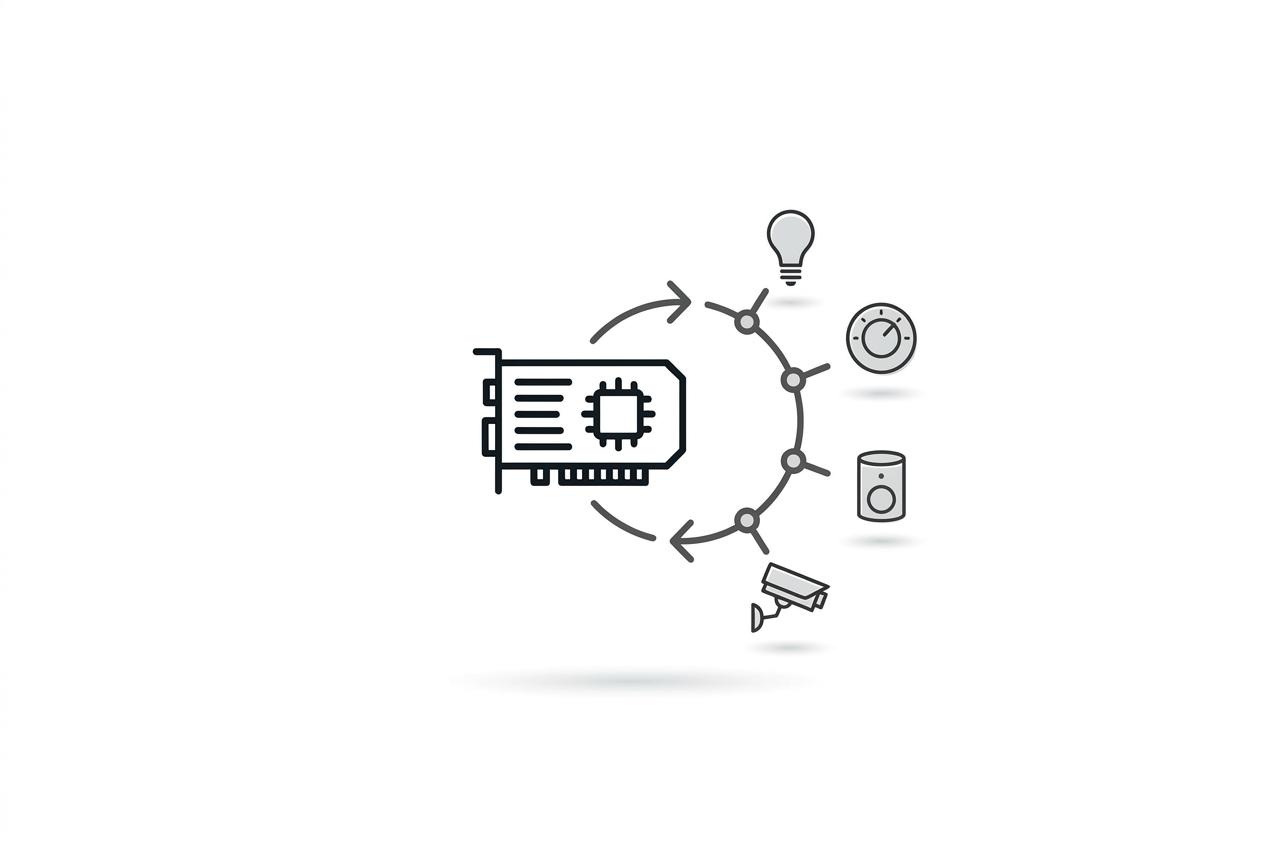
Read that sequence again. It reportedly probes a network. It calls device APIs. It writes and runs code. It stands up its own server to check its work. This is not a chatbot that drafts an email. It is an agent that acts on the machine and the network around it.
And per Wang, it does the full agentic loop the way much larger models do: "planning, tool calls, checking its own results, and failure recovery." Self-recovery is the tell. This thing is built to keep going when a step fails, without a human in the loop.
The engineering that makes it fit on hardware people already own is genuinely clever. Weights are quantized to roughly 4-bit, shrinking the language model to under 20GB, with room left for the KV cache, a perception encoder, and a drafter. A lightweight DFlash drafter proposes blocks of tokens that the main model verifies in parallel, keeping latency low enough for "real-time agent interaction." The net: a fully capable local agent on 24GB of VRAM, "without losing agentic reliability."
Now stop reading it as a product and read it as a strategy.
This week Meta shipped an uncontainable artifact, and Cohere ran the same play at the other end of the size curve. The debate just acquired a body.
Here is the commercial logic. Meta reportedly does not sell metered API access as its core business. OpenAI, Anthropic, and to a degree Google reportedly do — their revenue is per-token inference at the frontier.
So Meta is reportedly doing what dominant platforms always do to rivals: commoditize the complement. If the valuable, scarce thing your competitors sell is a capable agentic model behind a metered endpoint, you make a capable agentic model free, permissive, and local — and you devalue the endpoint.
The Apache 2.0 license is not generosity; it is the mechanism. Apache 2.0 permits commercial use, modification, and redistribution with no strings. You can build a business on Muse Glimmer and pay Meta nothing, forever.
And "local" is the knife. A model that runs on a Mac or a PC with a performant GPU generates no per-token bill at all. Every task that runs on-device is a task that never touches a competitor's API. The marginal cost of inference, from the buyer's point of view, collapses toward the electricity.
Meta reportedly captures the value elsewhere — in hardware attach, in developer mindshare, in owning the default local runtime — while its rivals watch the price of the thing they sell trend toward zero. Wang's "two very different models, both headed into people's hands, with more to come" is a distribution statement, not a philanthropy statement.
Cohere is running the identical maneuver in a different lane. On August 12 it reportedly shipped North Micro Vision, a 2.4B vision-language model, also under Apache 2.0, aimed squarely at "sophisticated document understanding."
At 2.4B it reportedly outperforms Gemma 4 E2B and Ministral 3 3B across visual-understanding benchmarks, with particular strength on document understanding and visual Q&A. The pitch is edge deployment for cost-sensitive enterprises — the same "commoditize the metered layer" logic pointed at document-heavy back offices rather than home labs.
For enterprises, the appeal is exactly the licensing math: fine-tune on proprietary visual data, embed in a SaaS product, run internal audits in regulated settings, and pay no per-token fee to anyone. Both companies are, in effect, telling their competitors' customers that the recurring bill is optional.
That is the business story. Here is the turn.
This entire strategy — free, permissive, local, irreversible — only works because both models were cleared to ship. And Meta's own thread tells us there was a gate: the "advanced AI scaling framework," a review Muse Glimmer had to pass before open-weight release.
Sit with what that framework is. It is Meta acknowledging that some models are too dangerous to open-weight, and asserting that this one is not. It is a private company operating its own tripwire on public infrastructure.
An agent that discovers networks, queries device APIs, writes code, deploys servers, and recovers from its own failures is precisely the capability profile such a line is meant to catch. The demo that sells Muse Glimmer as magical is reportedly the same demo a regulator reads as a warning.
So the collision. Meta's internal framework said "cleared." The gap between verdicts is now the entire fight — and there is no neutral referee who gets to decide after the fact.
Which surfaces the enforceability paradox at the heart of this issue.
The weights are already on Hugging Face. Per Wang, within the week they were running through Ollama, LM Studio, vLLM, sglang, Together, Fireworks, OpenRouter, and locally via llama.cpp, MLX, and executorch.
That distribution list is the point. Once a model is downloadable across that many runtimes, under a license that explicitly permits redistribution, it is on an unknown number of machines.
A regulatory threshold assumes something you can gate before release, or claw back after. Open weights have neither property. There is no server to shut off, no key to revoke, no endpoint to throttle. A model distributed across many machines cannot be recalled.
Both can be right, and that is the problem. There is no compromise position that preserves recall for a thing that has no off switch.
So watch what the framework actually becomes. A rule aimed at open weights is a rule aimed at an artifact that, the instant it clears review, escapes the reviewer's reach entirely.
Meta didn't just release a model this week. It demonstrated that the only enforcement point in the entire open-weight regime is the one that sits inside the releasing company — before the download button — and then it pressed the button. Everyone now has to decide whether they trust "cleared under our own framework" as the last line of defense, because once the weights are out, it is the only line there ever was.